Cart
0
If your car makes no sound at all when you turn the key, clicks once but won’t crank, or fires up only after you tap the fuse box, the starter relay is a prime suspect. Check the battery and grounds first, then run the tests below. If the starter stays engaged after you release the key, pull the key and disconnect the battery immediately.
TL;DR:
- Worn internal contacts or a sticky armature in the relay cause intermittent starting issues, especially after tapping or vibration.
- A relay with welded contacts can keep the starter engaged after you release the key, posing an immediate safety risk.
- Testing trigger voltage at pins 85 and 86 during cranking confirms whether the relay or upstream components are at fault, not just the relay itself.
- A battery resting below 12 volts, corroded terminals, or high resistance in grounds can mimic relay failure and should be tested first.
- Replacing a faulty relay is inexpensive, but persistent starter engagement or heat damage indicates a need for starter replacement rather than just relay swapping.
Table of Contents
- What Are the Symptoms of a Bad Starter Relay?
- Quick Checklist: What to Check Before You Swap the Relay
- Step-by-Step Tests: Multimeter, Jumper, and In-Vehicle Checks
- How to Rule Out the Battery, Solenoid, and Wiring
- When to Replace the Relay and What It Costs
- What Testing Hundreds of Starting Complaints Teaches You
- Get the Right Remanufactured Starter for Your Vehicle
- Sources
- FAQ
What Are the Symptoms of a Bad Starter Relay?
Starter relay symptoms cluster into a handful of patterns, and each one points to a different electrical fault. Learning to read them saves you from buying parts you don’t need.
No click, no crank at all usually means the relay isn’t getting triggered, or it has failed internally with an open coil. A single click with no crank is the classic bad-relay or weak-solenoid signature: the relay energizes but can’t deliver enough current to the starter motor. Rapid, repeated clicking most often traces back to a weak battery rather than the relay itself, since the starter tries to engage while voltage collapses under load.
Intermittent starts, especially ones that only work after you tap the relay or fuse box, point to worn internal contacts or a sticky armature inside the relay. This is mechanical wear, not a wiring problem, and it only gets worse.
The most dangerous symptom is a starter that keeps cranking after you’ve let go of the key. That means the relay’s contacts have likely welded shut, and current keeps flowing whether you want it to or not.
- No crank, no click: dead trigger circuit or failed relay coil
- Single click, no crank: relay or solenoid not sending full current
- Rapid clicking: usually a weak battery, not the relay
- Works only after tapping: worn contacts or sticky armature
- Starter stays engaged or you smell burning: welded contacts, an emergency
Several distinct fault patterns show up across common starter relay complaints, from no-crank silence to a starter that keeps spinning after the engine catches. Cold weather often exposes marginal relays that seemed fine all summer, since a sluggish battery combined with stiff internal relay springs is enough to tip a borderline part over the edge.
Quick Checklist: What to Check Before You Swap the Relay
Before you spend money on a new relay, rule out the usual impostors. Most “bad relay” complaints turn out to be something cheaper and simpler.
- Check resting battery voltage. A healthy battery reads roughly 12.0 to 12.6 volts at rest; anything meaningfully below that is your first suspect, not the relay.
- Inspect and clean the terminals and grounds. Corrosion at the battery posts or the engine-to-chassis ground strap causes voltage drop that mimics a failing relay.
- Run a basic voltage-drop check on the ground path. Excess resistance here starves the starter circuit even when the relay itself is perfectly healthy.
- Check the starter-related fuses and the relay socket. Look for a blown fuse, a loose seat, or discolored and melted plastic around the relay pins, which signals past overheating.
- Swap in a known-good relay of the same type. If you have a matching spare (many vehicles use identical relays for the fan, fuel pump, and starter), swap it in and note whether the symptom follows the relay or stays with the car.
- Perform the tap test and record the result. Turn the key while lightly tapping the relay or fuse box. If tapping temporarily restores cranking, that’s a strong practical sign of worn internal contacts.
Pro Tip: A tap test that works is not a fix, it’s a diagnosis. Treat a positive tap test as your cue to replace the relay before you get stranded, not as a green light to keep driving on it.
Step-by-Step Tests: Multimeter, Jumper, and In-Vehicle Checks
Relay pin layouts vary by vehicle, so confirm your specific relay diagram before testing, but the standard four-pin convention holds across most cars: 85 and 86 are the coil (trigger) side, 30 and 87 are the power (load) side.
- Locate the relay and identify the pins. Pull it from its socket and check the diagram printed on the relay body or the fuse box cover.
- Test coil resistance with the relay out of the circuit. Set your multimeter to ohms across pins 85 and 86. A healthy coil typically reads a measurable resistance within the expected moderate range; an “open” (infinite) reading means a dead coil, and a near-zero reading suggests an internal short.
- Check trigger voltage at 85/86 with the relay plugged in. Turn the key to START and probe those pins. You should see close to battery voltage; no voltage here means the fault is upstream in the ignition switch or safety switches, not the relay.
- Measure load-side voltage at 30/87 during cranking. With the relay engaged, you want close to full voltage passing through. A significant drop indicates burned contacts or corroded wiring on the power side.
- Try a careful jumper bypass. With the relay removed, a heavy jumper wire briefly connecting 30 to 87 should fire the starter directly. If the starter cranks fine on the bypass but not through the relay, the relay is confirmed bad.
- Bench-test the relay off the car. Apply 12 volts across the coil pins and check for continuity across 30 to 87 with a multimeter. A relay that clicks and shows continuity under power is good; one that stays open or won’t click is confirmed dead.
| Test point | What you measure | Healthy reading | Bad reading |
|---|---|---|---|
| Pins 85/86 (coil, key OFF) | Resistance | Tens of ohms | Open (infinite) or near zero |
| Pins 85/86 (key to START) | Trigger voltage | Near battery voltage | No voltage present |
| Pins 30/87 (during crank) | Load voltage | Near battery voltage | Significant drop |
| Bench test, 12V applied to coil | Continuity across 30 to 87 | Continuous, audible click | No click, no continuity |
How to Rule Out the Battery, Solenoid, and Wiring
A relay-shaped symptom doesn’t always mean a relay problem. Separating the actual cause from the impostors takes a few targeted checks.
- Battery versus relay: load-test the battery and watch how the headlights behave during a crank attempt. Heavy dimming under load, combined with resting voltage below the 12.0 to 12.6 volt range, points at the battery, not the relay.
- Starter solenoid: listen right at the starter itself, not the relay box. A single click there with the relay confirmed good usually means the solenoid or the starter’s internal contacts are the actual fault.
- Ignition switch and safety switches: if trigger voltage never reaches pins 85/86, check the park/neutral safety switch or the clutch interlock switch before you condemn the relay.
- Voltage drop on grounds and cables: anything over roughly half a volt of drop across a connection under load signals corrosion worth cleaning before replacing anything.
- Repeated blown fuses or high current draw: this pattern usually means an internal starter fault, like a shorted armature, drawing more current than the circuit was designed to handle.
When to Replace the Relay and What It Costs
Replace the relay outright when you find an open or shorted coil, no click despite confirmed trigger voltage, or contacts that are visibly welded or burned. Any of those results is a dead giveaway, not a maybe.
- Immediate action: if the starter stays engaged or you smell burning, pull the relay or disconnect the battery right away.
- Cost reality: relays are cheap, typically a small part cost plus a few minutes of labor.
- When it’s more than the relay: if the starter motor shows heat damage, a burned commutator, or repeated failures after a relay swap, the starter itself needs attention.
A welded relay contact is one of the few starting faults that qualifies as urgent, since the current keeps flowing after you’ve already turned the key off. If your tests point to actual starter damage rather than just the relay, a remanufactured starter is the practical next step instead of running a damaged unit until it strands you.
What Testing Hundreds of Starting Complaints Teaches You
Most people skip straight to buying a new relay because it’s the cheapest part in the starting circuit, and that instinct isn’t wrong, exactly. It’s just backwards in order. The relay should be the last thing you test, not the first thing you replace, because a $15 part is easy to blame and easy to swap, while a corroded ground strap or a tired battery will happily fake every symptom on this list.
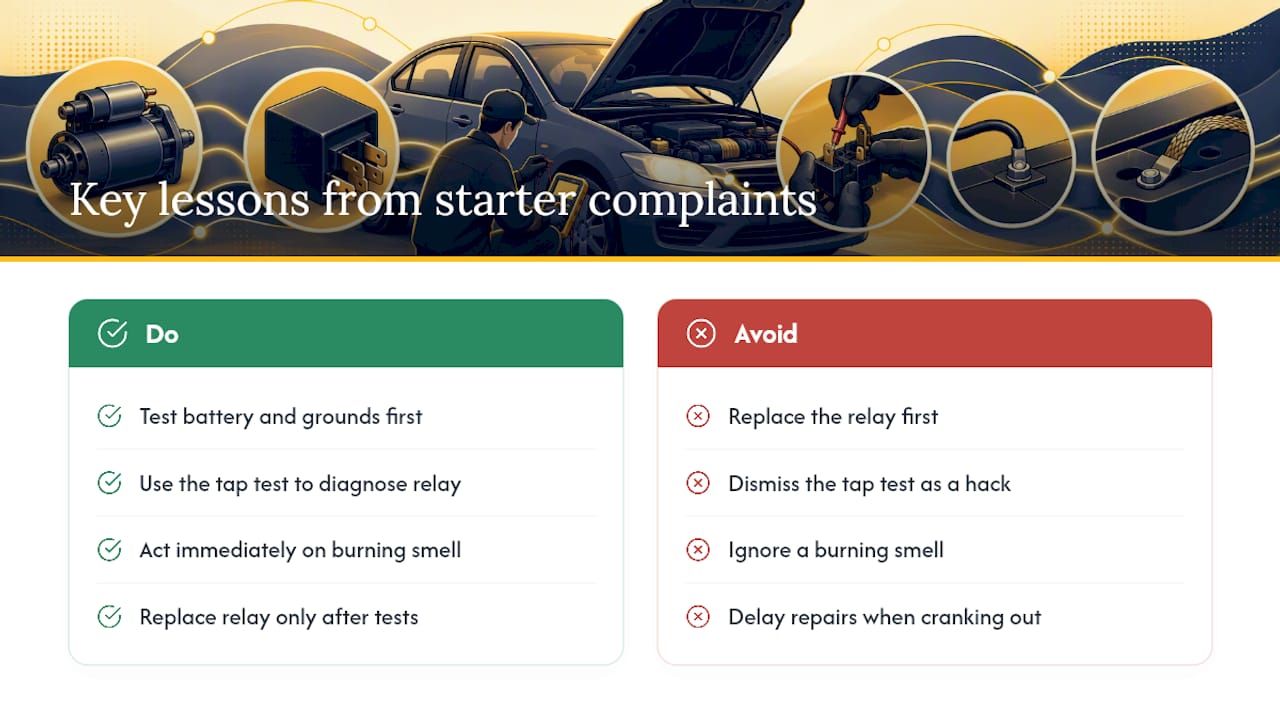
What’s underappreciated is how often the tap test gets dismissed as a hack. It isn’t. A relay that only works after a physical tap is telling you something specific: the contacts or the armature spring have degraded to the point where gravity and vibration matter more than they should. That’s not a maybe, that’s a countdown.
The other pattern worth flagging is the burning smell. Owners tend to treat it as a warning sign to watch, when it’s actually a warning sign to act on immediately. Welded contacts don’t heal themselves overnight in the driveway. If your starter is still cranking with the key out of the ignition, you’re not looking at a relay that might fail soon, you’re looking at one that already has, mid-failure, right now.
— Ismael
Get the Right Remanufactured Starter for Your Vehicle
If your testing points to starter damage rather than just a bad relay, replacing the starter with a fresh relay is only a temporary patch. Some companies rebuild starters and alternators with new internal components and test them to meet or exceed OEM specifications, avoiding the risk of a used part off a shelf.
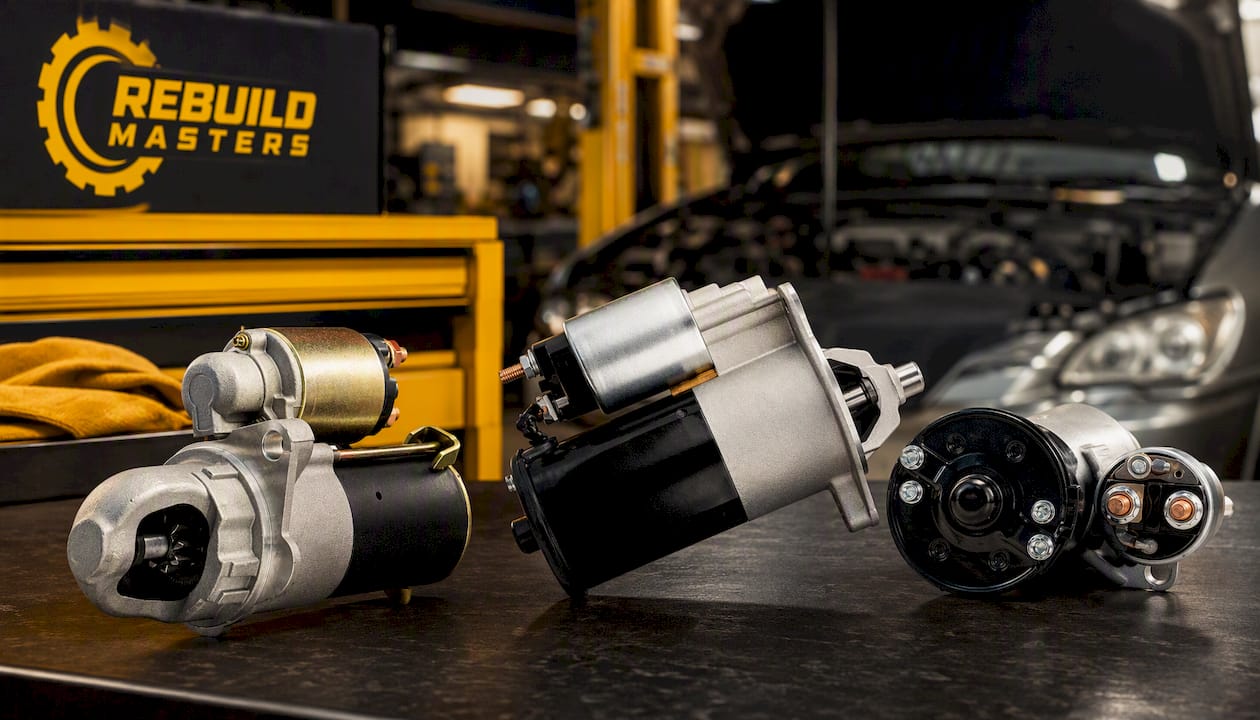
Rebuildmasters carries direct-fit starters for Chevrolet Cobalt, Cavalier, and Malibu models, along with options for older Ford F-Series trucks, Mustangs, and Expeditions and newer Ford Mustang, Explorer, and Ranger fitments. Every unit ships same-day when your order comes in on time, and it’s backed by a warranty since it’s rebuilt to OEM specifications rather than pulled off a used-parts shelf and resold as-is. Browse the full remanufactured starters lineup or check the rebuilt starters category page to confirm fitment against your VIN, and reach out to support if your exact application isn’t listed. Charging issues often ride along with starting problems, so it’s worth checking the rebuilt alternators selection too if your battery keeps running low between drives.
Sources
- How to perform simple charging and starter system voltage-drop tests — Hemmings
- Common symptoms of a faulty starter relay — Innova
- Starter relay symptoms, testing, wiring & replacement guide — Digi-Electronics
- How to test a starter relay – Step-by-step guide — Origin-IC (ODG)
- Symptoms of a bad or failing starter relay — YourMechanic
FAQ
What Are Common Relay Failure Symptoms?
The most common ones are no crank with no click, a single click but no crank, intermittent starts that improve after tapping the relay, rapid clicking, and a starter that stays engaged after the key is released. Each pattern points to a different electrical fault, from a dead coil to welded contacts.
Will a Bad Relay Stop a Car From Starting?
Yes. Since the relay carries the high-current signal to the starter solenoid, a relay with an open coil or worn contacts can prevent the starter from engaging at all, even with a fully charged battery. This is why testing trigger voltage at the relay’s coil pins is one of the fastest ways to confirm the relay as the culprit.
Can a Bad Starter Relay Drain the Battery?
A relay with contacts stuck closed can keep current flowing to the starter circuit even with the key off, which will drain a battery quickly and risks damaging the starter itself. If you notice the starter engaging or spinning unexpectedly, disconnect the battery immediately.
How Long Does a Starter Relay Typically Last?
Starter relays don’t have a fixed replacement interval and often last for years without issue, but heat cycling, moisture, and heavy daily use gradually wear the internal contacts and spring. A relay that only works after a tap test has already reached the end of its practical life, regardless of its age in years.
Do I Need a Starter Relay or a New Starter?
Test the relay first with a bench check and a jumper bypass before assuming the starter is bad. If the starter cranks fine on a direct bypass but not through the relay, you need a relay; if it doesn’t crank even on bypass, or shows heat damage, a remanufactured starter is the more likely fix.