Cart
0
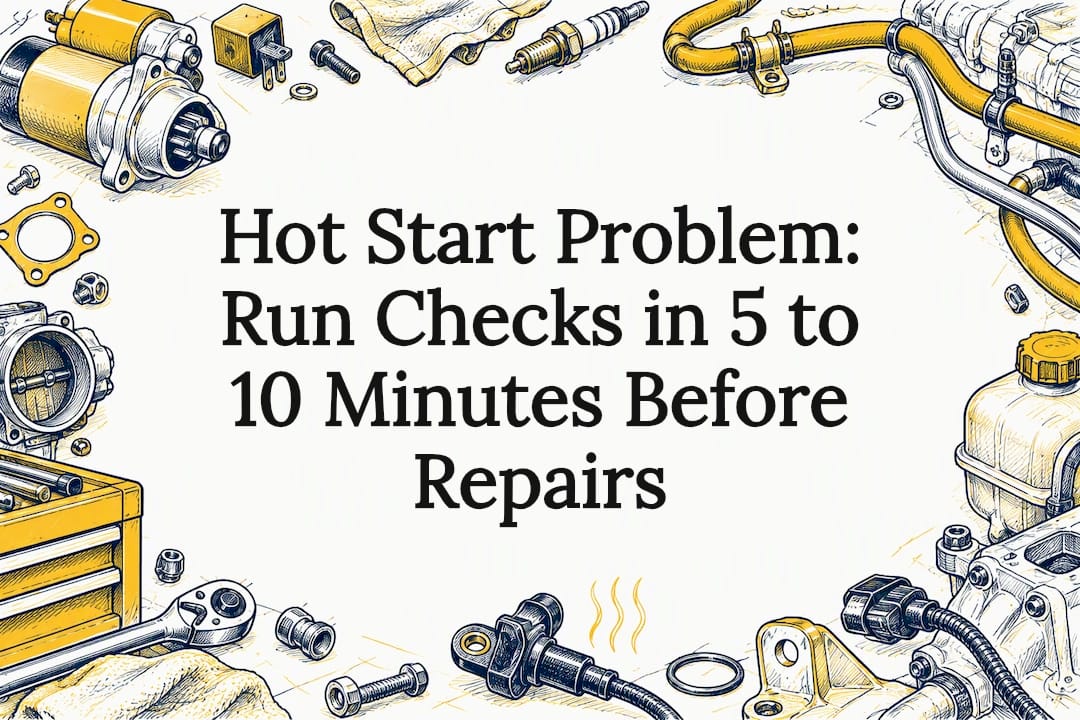
A hot start problem means your engine cranks but struggles or fails to start after it has run and sat warm for a few minutes to an hour, and the most common causes fall into five groups: heat-sensitive sensors and ignition components, starter or relay heat soak, weak fuel pressure, vapor lock in older fuel systems, and heat-stressed electrical connections. Start with the quick checks below, then move into the full diagnostic workflow if the problem persists.
TL;DR:
- Check battery voltage first: about 12.6 volts at rest is healthy, while dimming lights or a cranking voltage drop points to battery or connection trouble.
- Compare fuel pressure before and after a hot soak; a drop of several PSI points toward a failing pump, regulator, or in tank pre pump.
- Watch crankshaft and camshaft signals during a failed start; missing or erratic pulses confirm a sensor fault, and stored codes may record the event.
- If tapping the starter after heat soak makes the engine start, suspect the starter, but test its relay too because relay failures mimic starter faults.
Table of Contents
- How Heat Causes Starting Failures in Fuel, Sensors, Starters, and Wiring
- Step-by-Step Diagnostic Workflow to Find the Cause
- Fast Checks You Can Run in 5 to 10 Minutes
- Repair Options: What to Replace and What It Costs
- How Rebuild Masters Approaches Heat-Related Starter and Alternator Failures
- Preventive Maintenance to Keep Hot Start Problems from Coming Back
- What Years in the Shop Teach You About Hot Start Problems
- Get a Reman Starter or Alternator Built for Your Exact Vehicle
- FAQ
- Sources
How Heat Causes Starting Failures in Fuel, Sensors, Starters, and Wiring
Heat changes the physical behavior of fuel, electronics, and mechanical parts in ways that are easy to miss until you know what to look for. Extreme under-hood temperatures can interfere with a car’s ability to start because fluids evaporate, circulation is diminished, and fuel may not move through the system the way it should, according to AAA’s research on heat and vehicle performance. That single mechanism explains a large share of hot start complaints.
Fuel systems suffer first. Gasoline vaporizes more readily at high temperatures, and in older carbureted or early fuel-injected vehicles that can trigger vapor lock, where vapor bubbles form in the fuel line and block liquid fuel from reaching the engine. Even in modern fuel-injected cars, a weak fuel pump or a failing pressure regulator may deliver just enough pressure when cold but fall short once heat reduces pump efficiency.
Sensors and ignition components come next. Several parts are known for working perfectly when cool, then failing intermittently once heat expands internal components or stresses solder joints. A hot-start diagnostic guide built around this exact failure pattern lists the fuel injection relay, the crankshaft position sensor, and Hall effect sensors as frequent culprits, often traced to cracked solder joints or thermal expansion inside the sensor housing, per the Volvo hot start diagnostic guide.
Starters and relays have their own heat-soak problem. A starter motor sits close to the exhaust manifold on most vehicles, and after the engine runs and heat radiates into the starter housing, worn brushes, a weakened solenoid, or expanding internal components can prevent the starter from engaging even though the battery is fine. You can confirm starter heat soak with a handful of simple tests before buying a replacement part.
High under-hood temperatures also generally stress the electrical system. Battery performance drops under sustained heat exposure, connections corrode faster, and an overheating alternator can mask itself as a starting problem when it is actually a charging problem.
Matching your symptom pattern to a system narrows the search:
- Cranks normally but won’t start: points toward fuel delivery, a dead sensor signal, or a weak spark.
- Cranks slowly or not at all: points toward the starter, battery, or a bad ground.
- Starts then dies within seconds: points toward a failing fuel pump, a clogged filter, or an intermittent sensor dropout.
- Runs rough for a few seconds before smoothing out: points toward a sensor supplying an inaccurate signal during the heat-soaked state.
Step-by-Step Diagnostic Workflow to Find the Cause
Guessing which part failed wastes money and time. A structured sequence that starts with the cheapest and easiest tests, then narrows toward fuel, sensors, and finally the starter, keeps you from replacing good parts.
- Document the pattern first. Note how long the vehicle sat after driving, whether the issue happens every time or only in extreme heat, and whether any recent repairs or part swaps preceded the symptom.
- Check for recalls. If the issue affects a wide range of vehicles of your make and model, search Safercar for an open recall tied to starting components before spending on diagnosis.
- Test battery voltage at rest and during crank. A healthy battery reads around 12.6 volts at rest and should not collapse significantly while cranking; a bigger drop suggests battery or connection trouble rather than a heat-sensitive part.
- Scan for codes. Plug in an OBD-II scanner and pull pending and stored codes, then check freeze-frame data for anything logged at the moment of the failed start.
- Inspect visually. Look at fuses, grounds, and visible wiring near the starter and fuel pump for corrosion, loose connectors, or melted insulation.
- Run a hot-soak fuel pressure test. Attach a fuel pressure gauge and compare the reading hot versus the reading cold; a drop of several PSI after heat soak points toward the pump, the regulator, or a failing in-tank pre-pump.
- Listen and check the gas cap. A hissing sound when you slowly remove the fuel cap after a hot soak can indicate a defective vent, which affects fuel system pressure behavior, per the Volvo diagnostic guide.
- Check live sensor data. With the scanner in live-data mode, watch crankshaft and camshaft position sensor signals during a failed hot start attempt; missing or erratic pulses confirm a sensor fault rather than a fuel or starter issue.
- Inspect connectors and shielding. Heat-cracked wire insulation or a corroded connector near the crank sensor can cause the exact intermittent dropout you are chasing.
- Swap or bench-test the relay. Relay failures mimic starter failures closely, and a set of relay-specific DIY tests can rule out the relay before you buy a starter.
- Escalate to shop-level tools when needed. Oscilloscope testing of sensor waveforms, in-tank fuel pump current draw tests, and bench-testing a pulled starter under simulated heat require equipment most owners do not have; stop DIY testing once you have narrowed the fault to a specific system and move to a shop or to part replacement.
Pro Tip: Write down the exact minute count between shutting the engine off and the failed start attempt. A fault that appears at 15 minutes but not at 45 minutes behaves very differently from one that only shows up after a full hour, and that detail alone can rule out two or three suspects.
Fast Checks You Can Run in 5 to 10 Minutes
Before pulling any part, run these quick checks. They take minutes and often point you straight to the right system.
- Watch the dash while cranking. Dim headlights or a flickering dash during a failed crank usually means battery or connection trouble, not a sensor or fuel issue.
- Pull codes with an OBD-II scanner. Even a basic scanner captures pending codes and freeze-frame data that can show a sensor dropout the instant it happens.
- Listen for the fuel pump. Turn the key to the “on” position without starting and listen for a two-second pump hum; silence suggests a pump or relay problem.
- Smell for fuel or listen at the cap. A fuel odor or a hiss when removing the gas cap after hot soak points toward pressure or venting trouble in the fuel system.
- Tap the starter after a hot soak. If a light tap on the starter housing gets the engine running immediately, you are very likely looking at a worn starter or solenoid.
- Check grounds near the starter and fuel pump. A loose or corroded ground strap causes symptoms that look identical to a failing part, and it costs nothing to check.
Repair Options: What to Replace and What It Costs
Once testing points to a specific system, the repair choice gets straightforward. A starter showing heat-soak symptoms, confirmed by the tap test or a bench test, is a direct replacement candidate, and a remanufactured starter rebuilt with new brushes, a tested solenoid, and fresh bushings addresses the worn components that caused the original failure rather than just swapping in another aging part.
Sensor faults deserve confirmation before replacement. A crankshaft or camshaft position sensor, or an engine coolant temperature sensor, should show a confirmed dropout or an out-of-range reading on live data before you buy one, since these sensors are inexpensive individually but easy to misdiagnose without a live-data check.
Fuel system repairs depend on where the pressure loss shows up. A weak pre-pump inside the tank, a tired main fuel pump, or a regulator that cannot hold pressure under heat all produce the same hot start symptom but need different parts, so confirm with the hot-soak pressure test before ordering anything.
Electrical fixes are often the cheapest wins: cleaning a corroded ground, replacing a relay with a properly rated unit, or repairing a heat-cracked connector near the starter or fuel pump resolves a surprising number of hot start complaints without replacing any major part.
- Starter replacement: moderate cost, moderate labor time, highest payoff when heat-soak testing confirms the starter.
- Sensor replacement: low part cost, requires confirmed live-data readings first to avoid guessing.
- Fuel pump or regulator replacement: moderate to higher cost depending on in-tank access, confirm with a pressure test first.
- Electrical cleanup: lowest cost, worth doing before any part replacement.
Repair budgets for vehicle owners vary enormously by vehicle class. For context on how wide that range runs at the high end, exotic and supercar owners can expect to budget between $6,000 and $115,000 a year on maintenance, a reminder that even within “normal” repairs, vehicle class drives cost more than the fix itself. For most daily-driven vehicles, a starter or sensor replacement sits far below that range, and a professional diagnosis becomes cost-effective once DIY testing has ruled out the cheap fixes and still leaves the cause unclear.
When you do order a replacement starter or alternator, confirm exact fitment against your vehicle’s year, make, and model before checkout, and keep your warranty paperwork on hand in case the part needs service later.
How Rebuild Masters Approaches Heat-Related Starter and Alternator Failures
Remanufacturing a starter or alternator is not the same as installing a used part pulled from a salvage yard. Each core goes through disassembly, replacement of wear items, and a full round of bench testing before it ships.
- Worn brushes, bushings, and solenoid components get replaced with new parts rather than reused.
- Solenoids are bench-tested under load to catch the kind of intermittent fault that only shows up once a part heats up.
- Armatures are balanced to reduce vibration-related wear that accelerates heat damage over time.
- Every unit undergoes electrical testing to confirm it meets or exceeds OEM output specifications before it leaves our facility.
We back every rebuilt starter and rebuilt alternator with a warranty and offer same-day shipping for urgent repairs, so a confirmed hot-soak starter failure does not have to leave a vehicle parked for days. Our diagnostic write-ups, including the starter heat-soak test guide, walk through the same tap tests and bench checks referenced in this article.
Preventive Maintenance to Keep Hot Start Problems from Coming Back
Most hot start problems that return within a year trace back to a component that was already marginal before the first failure. A few habits reduce that risk.
Keep an eye on your charging system year-round, not just when a problem appears. A failing alternator forces the battery to work harder and run hotter, which accelerates the wear that causes future starting trouble; our guide on diagnosing alternator overheating covers what to check before the alternator fails outright.
Replace aging grounds and connectors near the starter and fuel pump proactively, especially on a vehicle that has already shown one heat-related symptom. Corrosion and heat-cracked insulation rarely stay isolated to one spot once they start.
Watch for early signs of a failing starter, such as a slow or grinding crank, before it progresses to a full heat-soak no-start. Catching a worn starter early turns a roadside breakdown into a planned replacement.
Keep fuel system components, especially the pump and filter, on a reasonable replacement schedule rather than running them until they fail. A fuel pump that is already weak will show its weakness first under heat, and replacing it before that point avoids the diagnostic guesswork entirely.

What Years in the Shop Teach You About Hot Start Problems
The biggest mistake I see is parts-swapping: buying a sensor, then a relay, then a starter, hoping one of them fixes a problem that was never diagnosed. That approach is expensive and often leaves the actual fault untouched. Stepwise testing, with notes on exactly when and how the symptom appears, finds the real cause faster than any amount of guessing. If you are unsure which part fits your vehicle, reach out with your exact year, make, and model, and we can help confirm the right fit before you order.
— Ismael
Get a Reman Starter or Alternator Built for Your Exact Vehicle
Once testing points to the starter or alternator, we carry rebuilt parts matched to specific vehicle platforms rather than generic one-size-fits-all units.
- Common starter matches include the 3273 Starter for 05-10 Ford Mustang, 97-10 Ford Explorer, and 98-11 Ford Ranger and the 6493 Starter for 05-06 Chevrolet Cobalt, 02-05 Cavalier, and 04-06 Malibu.
- Common alternator matches include the 13940 Alternator for 02-06 Nissan Altima and the 11175 Alternator for 06-11 Honda Civic.
- Browse the full rebuilt starters and rebuilt alternators catalogs or send us your vehicle details for a fitment check.
- Shipping and warranty coverage apply when you need the part fast.
FAQ
Why Is My Car Cranking but Not Starting in Hot Weather?
A car that cranks but will not start in hot weather usually points to reduced fuel pressure, a heat-sensitive sensor dropout, or a weak spark rather than a dead battery. Running the quick checks above, especially the fuel pressure and live sensor data tests, narrows down which of those three is responsible.
What Does “Hot Start” Mean on a Car?
“Hot start” describes a vehicle that starts fine when cold but struggles or fails to start after the engine has run and then sat for a short period while still warm. The term covers several underlying causes, including heat-soaked starters, vapor lock, and sensors that fail only once they warm up.
Why Does My Car Start Fine When Cold but Not When Hot?
This pattern almost always traces to a component that performs normally at normal temperature but loses function once heat expands or stresses it internally, most often a sensor, relay, or starter solenoid. The Volvo hot start diagnostic guide documents this exact behavior in several common ignition and sensor components.
Can a Starter Get Too Hot and Stop Working?
Yes, a starter mounted near the exhaust manifold can absorb enough heat after the engine runs to cause worn brushes or a weakened solenoid to fail temporarily, even though the starter works fine once it cools. Tapping the starter housing after a hot soak and testing whether the engine starts immediately afterward is a reliable way to confirm this specific failure pattern.
How Do I Know If It’s the Starter or the Battery?
Check battery voltage during cranking first: a healthy battery should read around 12.6 volts at rest and should not collapse significantly while cranking, and dim headlights or a flickering dash during a failed start point toward the battery or a connection. If voltage holds steady but the starter still will not engage after a hot soak, the starter or its relay is the more likely cause.
Sources
- Can the Heat Affect Your Car? | AAA Club Alliance
- Volvo 700 900 Hot Start Problem Diagnosis and Repair
- Safercar