Cart
0
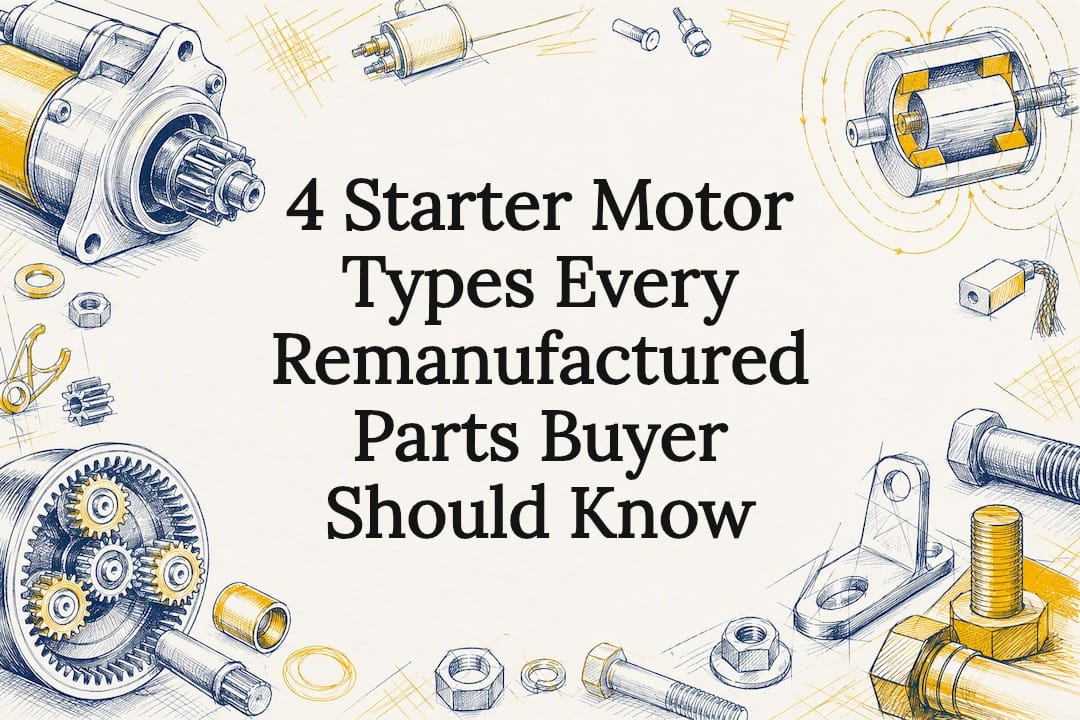
Every replacement starter on the market falls into one of four families: gear reduction, direct drive, permanent-magnet, and high-torque and heavy-duty. The type dictates weight, electrical draw, and how well the unit cranks a cold engine. Match the family to your engine, confirm mounting, rotation, and pinion tooth count against the original, then buy a remanufactured unit with documented bench testing and a real warranty. Skip that step and you risk a starter that bolts on but never cranks right.
TL;DR:
- Gear reduction starters are now standard in most modern vehicles because they offer lower electrical demand and better cold-start performance compared to direct drive units.
- Proper fitment verification requires checking VIN, engine code, rotation direction, pinion tooth count, and ensuring all replacement components were properly installed during remanufacturing.
- Rebuilt starters that have all wear parts replaced and undergo documented testing are as reliable as new, preventing early failures common in poorly remanufactured units.
- Choosing the correct starter family depends on the vehicle’s engine size, application, and service environment, with high-torque models designed for large or commercial engines.
- When buying remanufactured starters online, always verify warranty coverage, component replacement details, and ensure same-day shipping options are available for urgent repairs.
Table of Contents
- Starter Motor Types Explained: Gear Reduction, Direct Drive, Permanent-Magnet, and Heavy-Duty
- Gear Reduction vs Direct Drive vs Permanent-Magnet: How They Compare on the Things That Matter
- How to Buy the Right Remanufactured Starter: A Buyer’s Checklist
- What Remanufacturing Quality Actually Prevents
- Match Your Vehicle to an In-Stock Rebuilt Starter
- Sources
- FAQ
Starter Motor Types Explained: Gear Reduction, Direct Drive, Permanent-Magnet, and Heavy-Duty
Each starter family solves the same problem, spinning an engine fast enough to fire, in a different way. The differences show up in weight, current draw, and where you’ll find each one under the hood.

Gear reduction starters use a planetary gear set between the motor and the pinion. That gearing lets the motor itself spin faster while drawing less current to produce the same cranking torque, which is why gear reduction has become the default on most modern passenger cars and a growing share of heavy-duty applications. Delco Remy’s 39MT gear reduction starter line, built for heavy-duty engines, includes an overrunning clutch and electrical soft-start engagement, features aimed squarely at reducing wear during repeated cranking cycles.
Direct drive starters skip the gearing entirely. The armature shaft drives the pinion directly, which keeps the design simple and easy to service but demands more current for the same output. You’ll find these mostly on older vehicles and some simpler commercial engines where serviceability mattered more than shaving amps.
Permanent-magnet starters replace the field coil windings with magnets, cutting weight and improving efficiency. Because there’s no field coil drawing current, PM starters run cooler and lighter, a combination that made them common in modern light vehicles. Combine permanent magnets with gear reduction and you get the design showing up in most new economy and mid-size cars: a geared PM starter that reduces both weight and electrical demand compared to a conventional wound-field unit, with cold-cranking performance that still depends heavily on battery internal resistance and armature resistance.
High-torque and heavy-duty starters are built for large-displacement engines, diesels, and commercial fleets. They often run at higher voltage, use reinforced pinion designs, and in some off-highway or heavy equipment applications, manufacturers even wire multiple starters in parallel to turn over very large engines. This design detail is covered in Bosch’s heavy-duty starter technical brochure.
Quick summary of the four families:
- Gear reduction: lower current draw, planetary gearing, common in cars and heavy-duty engines alike
- Direct drive: simple, no gear reduction, higher current demand, found on older and some commercial vehicles
- Permanent-magnet: lighter, no field coil, common in modern light vehicles, often paired with gear reduction
- High-torque and heavy-duty: reinforced components, higher voltage options, built for large or commercial engines
One figure worth remembering: geared permanent-magnet starters can meaningfully cut electrical current demand versus a conventional wound-field starter while improving cold-cranking behavior, according to the engineering analysis of geared PM starter performance. That’s a real factor in cold climates, where every extra amp pulled from a marginal battery matters.
Gear Reduction vs Direct Drive vs Permanent-Magnet: How They Compare on the Things That Matter
The starter families above aren’t interchangeable just because they all spin a flywheel. Electrical demand, torque delivery, and fitment specifics separate them in ways that affect reliability and cost.
Electrical demand and cold cranking. Gear reduction and permanent-magnet designs both reduce peak current compared to a direct-drive wound-field starter, and the effect compounds when a vehicle sits in cold weather with a weaker battery. The geared PM starter analysis referenced above notes that cold-cranking performance still hinges on battery internal resistance and armature resistance working together, not the starter design alone. A remanufactured starter can’t fix a dying battery, but the right type reduces the load your battery has to supply.
Fitment specifics. Mounting flange bolt pattern, direction of rotation, and pinion tooth count all have to match the original. Tooth count differences between an OE starter and a replacement aren’t automatically a dealbreaker: Bosch’s own technical note on starter pinion teeth explains that manufacturers often compensate for a different tooth count by offsetting the shaft’s center point during production. Still, that compensation only works if it’s engineered correctly, so verify the exact cross-reference rather than assuming visual similarity means compatibility.
Failure modes by type. Brush wear and armature damage tend to hit direct-drive and older wound-field units hardest, since they run higher current for longer. Solenoid failure crosses all four families and is one of the most common reasons a starter clicks but won’t engage. Pinion and bendix wear shows up more in high-cycle applications, fleet vehicles that start dozens of times a day being a good example. When buying remanufactured, ask whether these specific wear components were replaced, not just cleaned and reinstalled.
- Brush and armature wear: most common in older direct-drive designs
- Solenoid failure: the leading cause of a “click but no crank” complaint across all types
- Pinion/bendix wear: accelerated by frequent starts, common in delivery and fleet vehicles
Pro Tip: If you manage a fleet with frequent start cycles, look specifically for a gear reduction starter with an overrunning clutch and soft-start engagement. Delco Remy builds this into its 39MT heavy-duty line precisely because repeated engagement is what chews up ring gears and pinions over time.
How to Buy the Right Remanufactured Starter: A Buyer’s Checklist
Getting the correct starter motor type isn’t the hard part. Getting a remanufactured unit that actually performs like new is. Here’s what to check before you order.
- Confirm fitment three ways. Cross-reference your VIN or engine code, not just the year and model, against the OE part number. Rotation direction and pinion tooth count matter as much as the mounting bolt pattern, and a part that looks identical can still be wrong.
- Ask what got replaced. A real remanufacturing process replaces wear components, brushes, bushings, the solenoid, bearings, not just a cosmetic cleanup. Rebuild Masters’ remanufactured starters process rebuilds each unit with new components and tests it to meet or exceed OEM specifications.
- Demand test documentation. Bench and torque testing, along with electrical load testing, should happen before a unit ships, not get skipped because “it looks fine.” This is where a lot of cheap aftermarket parts cut corners, and it’s the difference between remanufactured and rebuilt that actually matters.
- Check the warranty terms. A short or vague warranty is a red flag. Know what’s covered and for how long before you buy, not after it fails again in six months.
- Understand the core policy and turnaround. If you’re a mechanic or fleet manager facing a down vehicle, same-day shipping can be the difference between one lost day and three.
| What to verify | Why it matters |
|---|---|
| VIN/engine match, not just year/model | Prevents ordering a visually similar but incompatible unit |
| Rotation, mounting flange, tooth count | Wrong rotation or mount means the starter won’t engage at all |
| Component replacement list | Confirms brushes, bushings, solenoid, and bearings were actually replaced |
| Bench and electrical load test results | Verifies the unit performs to OEM spec before it ships |
| Warranty length and coverage | Protects you if a remanufactured defect surfaces later |
What Remanufacturing Quality Actually Prevents
Most starter failures I see traced back through warranty claims aren’t design flaws. They’re corners cut during a rebuild: a solenoid that got reused instead of replaced, bushings that were “close enough,” no real load test before the unit shipped. That’s the gap between a part that’s merely rebuilt and one that’s properly remanufactured.
This approach treats every unit as a full teardown, not a patch job. Parts get rebuilt with new components and tested to meet or exceed OEM specifications, with same-day shipping available when a vehicle is down and waiting isn’t an option. That combination, real component replacement plus documented testing, is what actually prevents the “click but no crank” callback that plagues cheap aftermarket starters. The starter motor type you choose matters, but a poorly remanufactured unit of the right type will still fail early.
— Ismael
Match Your Vehicle to an In-Stock Rebuilt Starter
Starters are rebuilt with new components and tested to OEM specifications before shipping, backed by a warranty and same-day shipping when you’re racing a repair deadline. That’s the practical edge over a generic aftermarket part pulled off a shelf with no documented testing behind it.

If your vehicle falls into one of the popular fit ranges, you can shop in-stock examples directly: the 3273 starter covers the 2005 to 2010 Ford Mustang, 1997 to 2010 Ford Explorer, and 1998 to 2011 Ford Ranger. The 3267 starter fits the 1997 to 1998 F-Series, 1996 to 2004 Mustang, 1997 to 1998 Expedition, and 1997 to 2005 E-Series. GM owners running a 2000 to 2005 Yukon, Suburban, or Silverado/Sierra can check the 6492 starter. Browse the full rebuilt starters catalog, or the rebuilt alternators line if your electrical issue points elsewhere, match your VIN and engine code to the listed application, and place your order or reach out to support if you’re not sure which unit fits.
Sources
- Analysis and Performance of a Geared Permanent Magnet D.C. Starter Motor
- 39MT™ Heavy Duty Gear Reduction Starter | Delco Remy
FAQ
How Do I Know Which Starter Motor Type My Vehicle Needs?
Check your OE part number against your VIN and engine code rather than relying on year and model alone. The starter type (gear reduction, direct drive, permanent-magnet, or heavy-duty) is set by the manufacturer, so your job is confirming the exact replacement, not choosing a different family.
Does a Different Pinion Tooth Count Mean the Starter Won’t Fit?
Not necessarily. Manufacturers often compensate for tooth count differences by offsetting the shaft’s center point during production, but you should still verify the exact cross-reference before ordering rather than assuming compatibility.
Are Remanufactured Starters as Reliable as New Ones?
A properly remanufactured starter, one with wear components replaced and tested to OEM specs, performs comparably to new in most applications. Rebuildmasters rebuilds starters with new components and tests each unit to meet or exceed OEM specifications before shipping.
What’s the Difference Between Gear Reduction and Direct Drive Starters?
Gear reduction starters use planetary gearing to lower electrical current draw for the same cranking torque, while direct drive starters connect the motor directly to the pinion and typically draw more current. Gear reduction has become the standard in most modern vehicles and many heavy-duty applications.
What Should I Check Before Buying a Remanufactured Starter Online?
Confirm fitment against your VIN and engine code, ask what components were replaced during the rebuild, and check the warranty terms and turnaround time. Rebuildmasters lists warranty coverage and offers same-day shipping for urgent repairs on its rebuilt starters catalog.