Cart
0
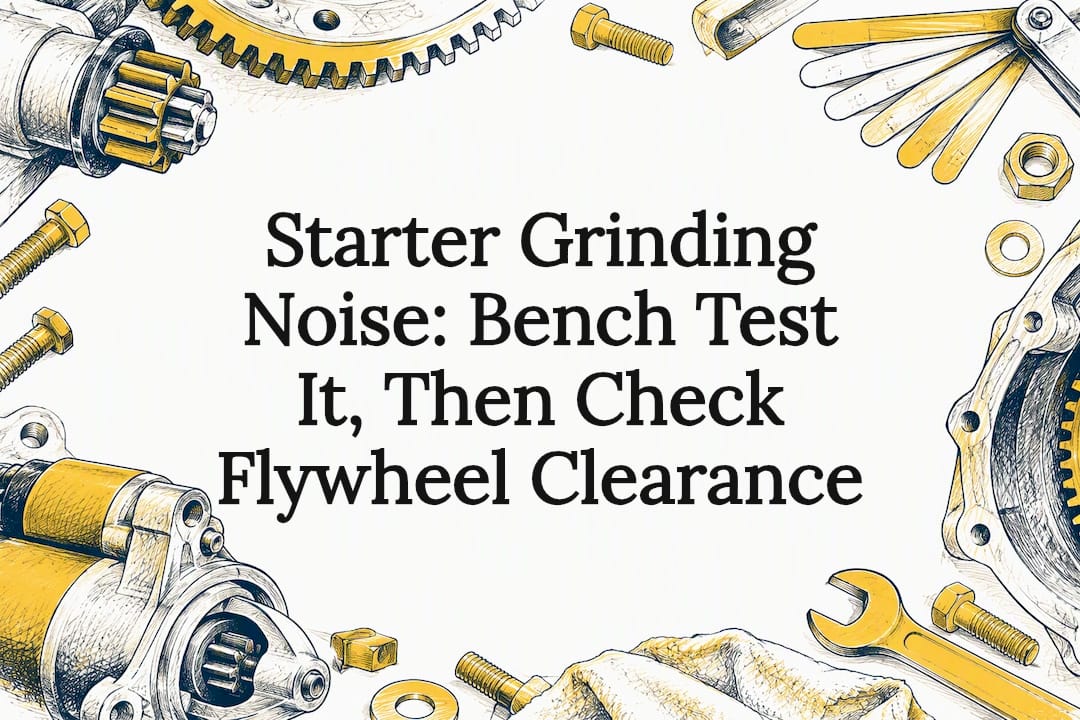
A grinding noise when you turn the key almost always points to the starter pinion failing to mesh cleanly with the flywheel or flexplate, often from worn gear teeth, a bad one-way clutch, or loose mounting. Stop cranking repeatedly, check your battery and connections first, then have the starter pulled for bench testing before you spend money on parts.
TL;DR:
- Dim headlights or loose, corroded battery connections point to electrical trouble; record whether grinding is intermittent, cold only, or continues after ignition.
- If the starter draws normal current and reaches proper speed on the bench but grinds when installed, suspect the ring gear.
- A common clearance target is about 0.060 inch between the resting pinion and flexplate; technicians may correct misalignment with shims or adapter blocks.
- Loud grinding, smoke, or a burning smell means stop cranking and tow the car, since continued attempts can damage the flywheel.
- Ring gear repairs usually require separating the transmission from the engine, so confirm the diagnosis before approving work beyond a starter replacement.
Table of Contents
- What causes starter grinding: mechanical vs electrical failures
- Quick troubleshooting steps you can do safely before removing the starter
- Removing and bench-testing the starter: what technicians check and why it matters
- Starter-to-flywheel clearance and alignment: measurement specs and common fixes
- Repair options, labor scope, and realistic cost drivers
- Why choose a tested remanufactured starter
- Author perspective and practical checklist
- Rebuild Masters options for a faulty starter
- FAQ
- Sources
What causes starter grinding: mechanical vs electrical failures
Grinding at startup usually comes from a mechanical problem inside the starter or on the flywheel, or an electrical fault that keeps the starter from engaging the way it should. Separating the two early saves you from replacing a part that was never the problem.
On the mechanical side, the pinion gear (sometimes called the Bendix) can wear down or chip, the ring gear teeth on the flywheel or flexplate can get damaged, or the one-way clutch inside the starter can fail and let the gear spin without biting properly. Loose mounting bolts or the wrong shim or adapter can also throw the pinion out of alignment, which changes how deeply it meshes with the ring gear. A starter that turns but doesn’t engage is frequently a mechanical issue rather than a dead starter, and pulling it for inspection is the advised next step.
Electrical faults rarely cause true grinding, but they can produce symptoms that feel similar: a weak battery, corroded terminals, a failing solenoid, or a faulty neutral safety switch can all keep the starter from engaging cleanly even when the motor itself is fine.
Listening closely helps you triage before you ever open the hood:
- Intermittent grinding that comes and goes usually points to damaged ring gear teeth rather than the starter itself.
- Grinding that continues after the engine fires means the starter isn’t disengaging, which can quickly destroy the pinion.
- A whirring sound without the engine turning over suggests the pinion is spinning but not catching the ring gear.
- A single sharp click with no crank usually means insufficient voltage reaching the solenoid or a solenoid fault.
Each of these points you toward a different fix, so pay attention before you call a shop.
Quick troubleshooting steps you can do safely before removing the starter
Before anyone pulls the starter, a few simple checks at home can rule out the cheap, common causes and give a technician useful clues.
- Turn on your headlights and interior lights, then try to start the car. Dim lights or lights that go out completely point to a weak or dying battery.
- Check the battery terminals and ground cables for corrosion or looseness, and clean and retighten them if they look rough.
- If you have a multimeter, check battery voltage at rest and watch how much it drops while cranking.
- Note exactly when the grinding happens: every start, only occasionally, only when the engine is cold or hot, or only if you hold the key longer than usual.
- Try starting in park and in neutral, listening for a difference between a click, a whirr, and actual grinding.
A light tap on the starter housing with a wrench can sometimes free up a worn Bendix long enough to get the car started, but that’s a stopgap, not a fix. It tells you the clutch mechanism inside the starter is likely worn, not that the problem is solved.
Pro Tip: Write down the exact pattern of the noise (cold only, every time, after holding the key) before you see a technician. It cuts diagnostic time significantly.
If you ever hear loud, continuous metal-on-metal grinding or smell burning or see smoke, stop trying to start the car. Have it towed instead. A loud grinding at startup is not normal, and continuing to crank the engine can turn a starter repair into a flywheel replacement.
Removing and bench-testing the starter: what technicians check and why it matters
Once the starter is off the car, a bench test tells you things you simply can’t learn with it still bolted to the engine. On a test stand, a technician measures amp draw and rpm under load, which reveals whether the brushes, windings, or internal drag are causing a problem. A proper starter test on a stand typically shows a healthy unit drawing roughly 60 to 150 amps with no load and up to 250 amps under load, depending on the starter type; high draw paired with low rpm usually means it’s time to replace the unit.
Beyond the electrical numbers, a visual inspection checks:
- Pinion and Bendix tooth condition for chipping, flattening, or uneven wear.
- One-way clutch behavior, confirming it locks and releases the way it should rather than slipping.
- Bushings and bearings for play or wear that lets the armature wobble.
- Armature binding, scoring, or visible damage from repeated grinding.
This step also maps out your repair path. If the starter draws normal amperage and spins at the right rpm but still grinds on the car, the problem is probably the ring gear, not the starter. If it drags, draws excessive current, or won’t spin freely, the starter itself needs rebuilding or replacement. That distinction keeps you from swapping a perfectly good starter for a flywheel problem, or the reverse.
Starter-to-flywheel clearance and alignment: measurement specs and common fixes
Even a fully healthy starter will grind if it isn’t positioned correctly relative to the flywheel or flexplate. Getting this clearance right is one of the most overlooked steps in a starter job.

Technicians commonly check starter-to-flexplate clearance using a drill bit as a gauge. With the pinion at rest, a clearance of roughly 0.060 inch between the end of the pinion and the leading edge of the flexplate is a common rule of thumb, and engagement depth should be verified once the pinion is meshed. When that clearance is off, shims or adapter blocks correct the vertical offset between the starter and the ring gear.
A few things commonly throw this off:
- A worn or incorrect adapter plate shifts the starter’s position relative to the flexplate, causing the pinion to engage too shallow or too deep.
- Missing or wrong-thickness shims leave the pinion sitting too close or too far from the ring gear.
- Flywheel or flexplate runout, or chipped ring gear teeth, can require machining or full replacement rather than a simple shim adjustment, which adds labor.
Pro Tip: Always recheck clearance with a drill-bit gauge after installing a new or remanufactured starter, even if the old one fit fine. Adapter wear or a slightly different casting can change the fit.
Correct torque on the mounting bolts matters just as much as the shim thickness. A starter that’s loose, even slightly, can walk out of alignment over time and start the grinding all over again.
Repair options, labor scope, and realistic cost drivers
What you pay to fix a grinding starter depends almost entirely on whether the problem is in the starter or on the flywheel.
A straightforward starter swap is the cheaper repair path: parts plus labor in most front-engine layouts, since the starter usually bolts on from outside the bellhousing. Choosing a remanufactured starter over a new one typically costs less while still meeting OEM specifications, as long as it’s bench-tested and properly shimmed on installation.
Flywheel or flexplate ring gear damage is a different story. Fixing chipped or worn ring gear teeth often means separating the transmission from the engine, or dropping the transmission entirely, to access the flywheel. That labor adds up fast compared to a starter-only job, which is exactly why ruling out ring gear damage early matters.
A few guidelines for choosing between repair paths:
- If the bench test shows a healthy starter but grinding continues on the car, suspect the ring gear, not the starter.
- If the bench test shows excessive amp draw, slow rpm, or visible internal wear, replace or rebuild the starter rather than reinstalling it.
- Insist on bench testing the old starter before paying for a new one. A shop that skips this step may be guessing at the diagnosis.
- Budget more labor time for flexplate or ring gear work than for a straight starter swap, since it often requires partial disassembly of the drivetrain.
Getting this diagnosis right the first time avoids paying twice for labor on the same noise.
Why choose a tested remanufactured starter
A remanufactured starter replaces the worn internals, such as the brushes, bushings, solenoid contacts, and often the one-way clutch, then gets bench-tested before it ever reaches you. That testing step matters because it confirms amp draw and engagement behavior meet or exceed OEM performance before the part goes back on the car, which lowers the odds of redoing the labor a second time.
Pairing a tested remanufactured starter with correct starter-to-flywheel clearance is, in most repairs, the most cost-effective way to fix the problem for good. The starter itself stops being the weak link, and proper shimming keeps the pinion engaging the way it was designed to.
A few things worth confirming before you finalize any starter job:
- Warranty terms, so you know what’s covered if the replacement unit ever acts up.
- Exact fitment, matching your vehicle’s year, engine, and trim rather than a generic cross-reference.
- That the installer bench-tests the old starter and verifies the new one’s fit and clearance before calling the job done.
We go deeper on how remanufactured units differ from simple rebuilds in our explainer on remanufactured versus rebuilt starters, and on what makes a remanufactured starter a reliable long-term fix for your starting system.
Author perspective and practical checklist
Grinding noises get chased the wrong way more often than not. Shops and DIYers alike jump straight to “replace the starter” without doing the cheap checks first, and that habit wastes money on parts that were never broken.
My order of operations: run the quick electrical checks, write down the exact symptom pattern, bench-test the starter, measure starter-to-flywheel clearance, and only then replace the starter with a tested remanufactured unit if the bench test says it’s bad. One thing stays true no matter how many starters you swap: if the ring gear is damaged, replacing starters repeatedly just burns labor without fixing anything.
— Ismael
Rebuild Masters options for a faulty starter
Once a bench test confirms your starter is the problem, ordering the right replacement comes down to matching your exact vehicle application. Our rebuilt starters are rebuilt with new internal components and tested before shipping, with same-day shipping available when you need the car back on the road fast.
A few examples of common fitments we carry, so you can see how specific the matching gets:
- The 3273 starter fits the 2005 to 2010 Ford Mustang, 1997 to 2010 Ford Explorer, and 1998 to 2011 Ford Ranger.
- The 3267 starter fits the 1997 to 1998 F-Series, 1996 to 2004 Mustang, 1997 to 1998 Expedition, and 1997 to 2005 E-Series.
- This starter fits selected Ford Expedition, F-Series, and Mustang models.
Before you order, bench-test the old starter to confirm it’s the actual cause, double-check your vehicle’s exact year and engine against the product listing, and follow your installer’s guidance on torque specs and shims so the new starter meshes correctly from the first start.
FAQ
What kind of noise does a bad starter make?
A failing starter can produce a grinding or screeching sound, a high-pitched whirring without the engine turning, or a single click with no crank at all. The specific sound often indicates which part is failing: grinding points to the pinion or ring gear, whirring points to a slipping clutch, and clicking points to low voltage or a solenoid fault.
How bad is it if my starter grinds on my flywheel here and there?
Occasional grinding is still a warning sign, not something to ignore. It often means the pinion teeth or ring gear are already chipped or wearing unevenly, and the problem typically gets worse and more frequent the longer it continues.
When I start my car, it sounds like metal grinding, what does that mean?
Metal-on-metal grinding at startup usually means the starter pinion isn’t meshing properly with the flywheel or flexplate teeth. A loud grinding noise at startup is not normal, and if it continues after the engine fires, shut it off and have the vehicle towed rather than risk further damage.
How do I stop my starter from grinding?
Start by ruling out battery and connection problems, then have the starter removed and bench-tested to confirm whether it’s the starter or the ring gear at fault. If the starter needs replacing, installing a properly fitted, tested unit and verifying starter-to-flywheel clearance with a drill-bit gauge prevents the grinding from coming back.
Can a bad one-way clutch cause starter grinding?
Yes, a failed one-way clutch inside the starter is a well-documented cause of excessive starter noise. An OEM service bulletin identified this exact failure and recommended starter replacement, with an ECM reprogramming step afterward where applicable.
Sources
- 5 ways your starter motor can fail, and how to deal with it – Haynes Manuals Australia
- Ask Away! with Jeff Smith: Troubleshooting an Engine Starter Motor with a Terrible Whine Noise
- Engine Not Starting Excessive Noise From Starter When Starting - 2017-2021 Subaru
- What Is the Grinding Noise When Starting a Car?