Cart
0

A fleet should stock alternators by application, not by vehicle count: keep one tested spare for each alternator part number that serves several of your vehicles, and replenish it the day you use it. That keeps a dead charging system from parking a truck for days, without tying up cash in a shelf of units that never move. A rebuilt alternator from Rebuild Masters is made in the USA with all-new components, tested to OEM specifications, backed by warranty, and ships the same day, which is what makes a lean shelf workable.
This guide covers the practical side: what to stock, how to estimate quantities, how to size a replacement, and how to confirm the alternator is really the problem before you spend a spare on it.
TL;DR
- Stock by part number. Group vehicles by the alternator they use, then keep one spare for each group that covers several units.
- Size every replacement for the worst-case duty cycle, with a 20 to 30% margin, and never go down in output from the original.
- Check battery state of charge, cables and voltage drop before you swap. Many repeat failures are wiring faults, not bad alternators.
- Rebuilt alternators from Rebuild Masters are tested to OEM specifications, warranty-backed and available with same-day shipping, so one spare per group can be enough.
- Review the shelf twice a year against what you actually pulled.
Table of Contents
- What alternator stocking really involves
- Step 1: Build the application list
- Step 2: Estimate how many units to keep
- Step 3: Size the replacement correctly
- Step 4: Confirm the alternator is the problem
- Step 5: Build charging-system checks into preventive maintenance
- Step 6: Choose the unit you stock
- A stocking checklist you can use this week
- Promo: stock the spares that keep routes running
- Our perspective
- FAQ
- Sources
What alternator stocking really involves
Stocking is a bet on two numbers: how long a vehicle can sit while you wait for a part, and how much money you are willing to leave idle on a shelf. A van that carries a route generates revenue every day. A spare alternator generates nothing until the day it saves that route.
So the goal is not “enough alternators.” It is the smallest shelf that makes a charging failure a same-shift repair. Three things shape that shelf:
- How many different alternators your fleet uses. Ten vehicles that take ten different units need a different plan than ten vehicles that take two.
- How often they fail in your duty cycle. Stop-and-go delivery work with accessories running is harder on a charging system than steady highway miles.
- How fast you can get a replacement. If a tested unit can ship the same day, your shelf can be thinner than if every order takes a week.
Step 1: Build the application list
Start with a simple table. One row per vehicle, with year, make, model, engine, and the alternator part number or output rating it carries now. Then group the rows by part number.
You will usually find that a handful of part numbers cover most of the fleet. Those are your stocking candidates. The oddballs, a single older truck or a specialty vehicle, are better handled by ordering when needed.
A few practical notes:
- Pull the part number off the installed unit when a vehicle is already in the shop, rather than trusting a decades-old spreadsheet.
- Record the output rating too. Equivalent-looking units can differ in amps, and that matters for the next step.
- Standardizing is worth considering at replacement time. When a fleet can move several vehicles to one common unit that suits them all, the shelf shrinks. Only do this where the output and fit genuinely match each vehicle.
Ford-heavy fleets show how grouping works. A single rebuilt unit, such as the 7791 alternator for 97-03 F-150/F-250, 97-04 E-Series, 97-02 Expedition and 98-99 Navigator, covers a whole family of trucks and vans. The 7750 for 93-01 F-Series, 93-96 Bronco, 91-00 Explorer and 92-05 Ranger does the same for another group, and the 7795 for 98-02 Crown Victoria, Town Car and Grand Marquis serves sedans still working in service fleets. One shelf slot can protect many vehicles.
Step 2: Estimate how many units to keep
There is no universal ratio, and any number quoted without knowing your duty cycle is a guess. Use your own history instead.
The method
- Count alternator replacements for each part-number group over the last 12 to 24 months from work orders.
- Divide by the months covered to get a monthly failure rate per group.
- Multiply by your replenishment time in months. If a replacement reaches you in a day or two, that is a small fraction of a month.
- Round up, and set a floor of one spare for any group that covers three or more vehicles.
A worked example (illustrative numbers, not benchmarks)
Say you run 30 cargo vans in two alternator groups: Group A has 20 vans, Group B has 10. Over 24 months, work orders show 6 alternator replacements in Group A and 2 in Group B.
- Group A: 6 over 24 months is 0.25 per month. With replenishment in about a week, expected demand during that wait is well under one unit. One spare covers it.
- Group B: 2 over 24 months is about 0.08 per month. One spare is still reasonable because a down van costs more than the carrying cost of a single unit, but you could also order on demand if same-day shipping is available to you.
The point is the logic: when replenishment is fast, the shelf only needs to cover the gap between the failure and the next delivery. When it is slow, you need more depth.
Adjust upward when
- Vehicles run long idle periods with heavy accessory loads, such as heaters, blowers, lighting or equipment.
- A group is aging and failures are accelerating.
- Vehicles operate far from your shop, so a breakdown is expensive to recover.
Adjust downward when
- The group has only one or two vehicles.
- You can order and receive a tested unit the same day.
Step 3: Size the replacement correctly
Stocking the wrong output is worse than stocking nothing. A unit that fits but cannot keep up leaves batteries drained and sends the truck back for a second repair.
Fleet Maintenance’s guidance for medium-duty trucks is that low-speed output matters most for vocational and pickup-and-delivery trucks, because those vehicles rarely reach freeway speeds. It recommends sizing for the worst-case use, the most starts and stops with the heater, blowers and wipers on high, and adding a 20 to 30% safety factor so batteries can recharge. The same article notes that a history of frequent jump-starts or battery replacements on an application is a signal to step up to a larger alternator, and that cables must be resized for the bigger unit.
Another Fleet Maintenance piece offers a rule of thumb: size the alternator so average electrical demand is under half its rated output. It adds that long-haul trucks and sleepers commonly average 50 to 70 amps over time, which points to at least a 100 to 140 amp unit, while local delivery trucks with constant starting and deep battery discharges can benefit from higher output. The same article explains that nameplate ratings are measured at 6,000 rpm and about 72°F, and that published output curves should be reduced by up to 15% for the heat of real operation.
What this means on the shelf:
- Never stock below the original output. Matching or exceeding the original rating is the safe direction for a replacement.
- Read the output at the rpm your vehicle actually runs. An alternator rated for a high number at high rpm may deliver far less at idle. Equipment World’s alternator buyer’s guide gives an example in which a 110-amp Ford unit produced only about 47 amps at a 600 rpm idle.
- Step up only when the vehicle needs it. The same guide notes that stock alternators are designed for short duty cycles and have limited capacity for added loads, and that a higher-output unit should exceed the accessory draw at the relevant speed, for example 160 amps at that speed for a continuous 100-amp need. Check belt capacity and cable sizing before upgrading.
Step 4: Confirm the alternator is the problem
A spare is only useful if it goes on a vehicle that needs it. A common waste in fleets is swapping a good alternator while the real fault, a loose or corroded connection, stays in place.
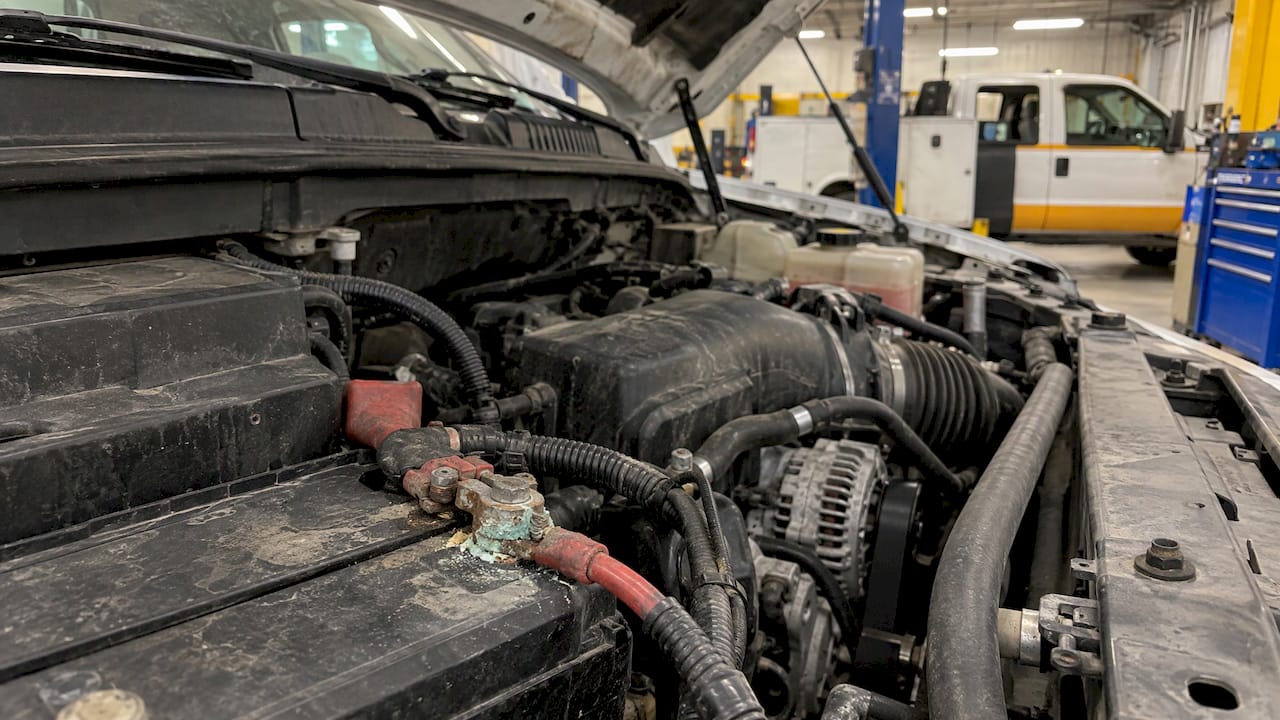
Fleet Maintenance reports that Mahle’s Bob Hopko sees many would-be alternator warranty claims turn out to be cable problems, and that voltage drop from relaxed connections can cause repeat failures if the alternator is replaced without fixing them. The article cites TMC Recommended Practice 129, which stipulates no more than a 0.5 volt drop for medium- and heavy-duty trucks.
A sound sequence before pulling a spare:
- Check battery state of charge. A weak or sulfated battery can mimic a charging fault and will kill a new alternator’s output claims.
- Inspect cables and grounds. Look for corrosion, heat damage, loose lugs and relaxed terminals.
- Measure voltage drop on the charging path under load, not only static voltage.
- Then test alternator output at the rpm and load the vehicle actually sees.
The Technology & Maintenance Council’s recommended practice, RP 129A, covers cranking and charging troubleshooting for 12-volt heavy-duty systems, so it is a handy reference for your shop procedure.
We have written the voltage drop steps out in more detail in our guide to alternator voltage drop and wiring faults, and for a unit that keeps failing, our article on the intermittent charging problem helps you find the cause before you order again. If a freshly installed unit still does not charge, see what to do when a new alternator is not charging.
Step 5: Build charging-system checks into preventive maintenance
Stocking is the backup. Preventive maintenance reduces how often you reach for it.
Public fleet contracts show how routine this is. The City of Santa Ana’s fleet maintenance agreement with the Orange County Fire Authority lists inspection of the charging system and battery load testing among the tasks in its scheduled “A” service for light-duty vehicles. If you run vehicles in Orange County, that is a good model for what a PM line item looks like.
A charging-system PM should include:
- Battery load test and state-of-charge check
- Belt condition and tension
- Cable, ground and connection inspection, with a voltage drop reading
- A charging output check at idle and at raised rpm
Log the readings. A slow decline in idle output on one vehicle is a better trigger for a planned swap than a roadside failure.
Step 6: Choose the unit you stock
For most fleet applications, a rebuilt alternator is a sensible shelf item. Rebuild Masters rebuilds every unit in the USA with all-new components, tests it to meet or exceed OEM specifications, and backs it with a warranty. Our parts are available for all major vehicle brands, across cars, trucks, vans, SUVs and specialty vehicles. For a fleet manager, that combination means the spare on your shelf is a unit you can put on a vehicle with confidence, and the one you reorder is a same-day shipment away.
If you want to understand what the testing involves, our article on what SAE testing means for remanufactured alternators explains it plainly, and what makes remanufactured parts reliable covers the standards behind a good rebuild. For a broader view on cost, see why more drivers are choosing remanufactured alternators.
Starters belong on the same list. They fail from the same wear and heat, and the same grouping logic applies. Our rebuilt starters range follows the same standards as the alternators.
A stocking checklist you can use this week
| Task | What to record | Why it matters |
|---|---|---|
| List vehicles by alternator part number | Year, make, model, engine, part number, output | Shows which groups justify a spare |
| Count replacements over 12 to 24 months | Failures per group | Gives a real failure rate |
| Note replenishment time | Days from order to delivery | Sets the depth of your shelf |
| Mark high-duty vehicles | Idle time, accessories, routes | Tells you where to size up |
| Set a minimum per group | One spare for groups of three or more vehicles | Keeps the shelf lean |
| Review twice a year | Spares used, spares added | Keeps stock matched to reality |
Promo: stock the spares that keep routes running
If your list shows a few alternator groups that cover most of your vehicles, those are the units to put on the shelf. Rebuild Masters offers rebuilt alternators for all major brands, each rebuilt with new components, tested to OEM specifications and backed by warranty, with same-day shipping for urgent needs.
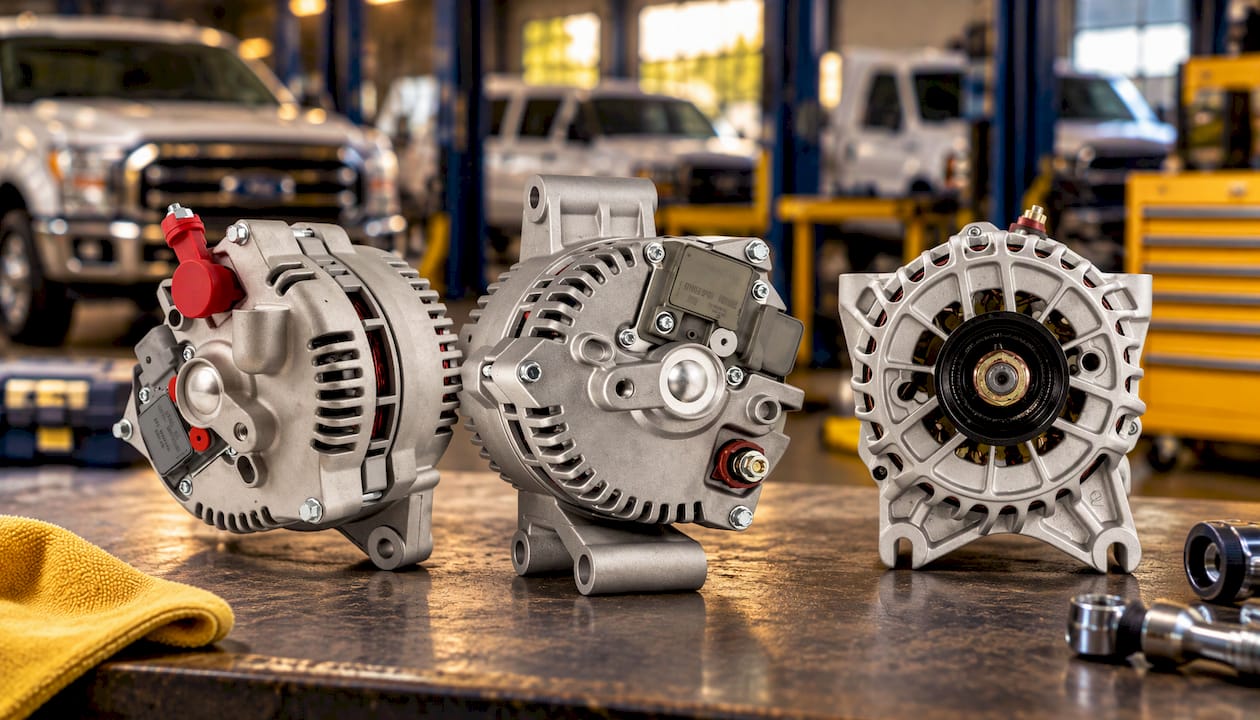
Find your application, order the spare, and put the part number on your stocking sheet.
Our perspective
Fleets rarely lose money on the price of an alternator. They lose it on the day a vehicle sits waiting for one, and on the second repair when the first one was the wrong diagnosis or the wrong output.
That is why we rebuild with all-new components and test every unit to meet or exceed OEM specifications. A spare on your shelf has to work the first time, because nobody checks it again until the truck is down. Our warranty and same-day shipping are there for the other half of the problem: when you use a spare, the replacement should be on its way the same day.
Our advice is simple. Group your vehicles by part number, keep one dependable spare per group, size for the hardest day your vehicle has, and check the wiring before you pull the unit. Do that and a charging failure becomes a short repair instead of a lost shift.
Ismael
FAQ
How many spare alternators should a small fleet keep?
Start with one spare for each alternator part number that serves three or more vehicles, then adjust from your own work orders. Count replacements over the past 12 to 24 months and compare them with how fast you can get a replacement. The faster the replenishment, the fewer units you need on the shelf.
Should I stock one alternator for the whole fleet?
Only where a single unit genuinely fits and meets the output needs of every vehicle it will serve. Standardizing can shrink the shelf, but never go below a vehicle’s original output, and check mounting, belt and cable capacity first. Where vehicles differ, stock by application group.
Is a rebuilt alternator a good choice for fleet stock?
Yes. Our rebuilt alternators are made in the USA with all-new components, tested to meet or exceed OEM specifications and backed by warranty. That makes them a practical spare for cars, trucks, vans, SUVs and specialty vehicles, with same-day shipping when you need to restock quickly.
How do I know the alternator is the problem and not the wiring?
Check the battery’s state of charge first, then inspect cables and grounds and measure voltage drop under load. For medium- and heavy-duty trucks, TMC RP 129 sets a limit of 0.5 volts of drop. Only after these checks pass should you test alternator output and replace the unit.
Sources
- Alternator advice for medium-duty trucks, Fleet Maintenance (2025)
- Getting to the heart of starter and alternator trouble, Fleet Maintenance (2018)
- Alternator Buyer’s Guide, Equipment World (2012)
- A Guide to TMC Recommended Practices
- City of Santa Ana and Orange County Fire Authority fleet maintenance agreement