Cart
0

An alternator can be covered by four different kinds of paper: the factory warranty on your vehicle, a service contract you bought, a recall, or the warranty on the part someone installed last time. Each has its own clock and its own exclusions. The coverage that matters most after a repair is the warranty on the replacement alternator itself, which is why we rebuild every alternator and starter with all-new components, test it to OEM specifications and back it with a warranty.
This guide shows how to work out which coverage applies to you, what a claim usually requires, and how to read a warranty before you buy a part.
TL;DR
- A longer powertrain warranty does not automatically include the alternator. On a newer vehicle it usually sits under the basic (bumper-to-bumper) coverage as an electrical component.
- Replacement-part warranties and service contracts both depend on a written diagnosis that names the failed part, and most require approval before any work starts.
- Installation errors, electrical modifications, collision damage and unauthorized repairs are the usual reasons claims are denied.
- Replacement-part warranties often stay with the person who paid for the repair, so the coverage may not pass to a buyer when you sell the vehicle.
- Compare any alternator warranty on five points: length, parts, labor, exclusions and how the claim works.
Table of Contents
- Four kinds of coverage that can apply to an alternator
- What each type usually pays for
- Why the diagnosis decides the claim
- What typically voids or limits alternator coverage
- What the law requires a written warranty to say
- How to compare alternator warranties
- Who benefits most from a good replacement-part warranty
- Perspective
- Get a rebuilt alternator or starter with a warranty
- FAQ
- Sources
Four kinds of coverage that can apply to an alternator
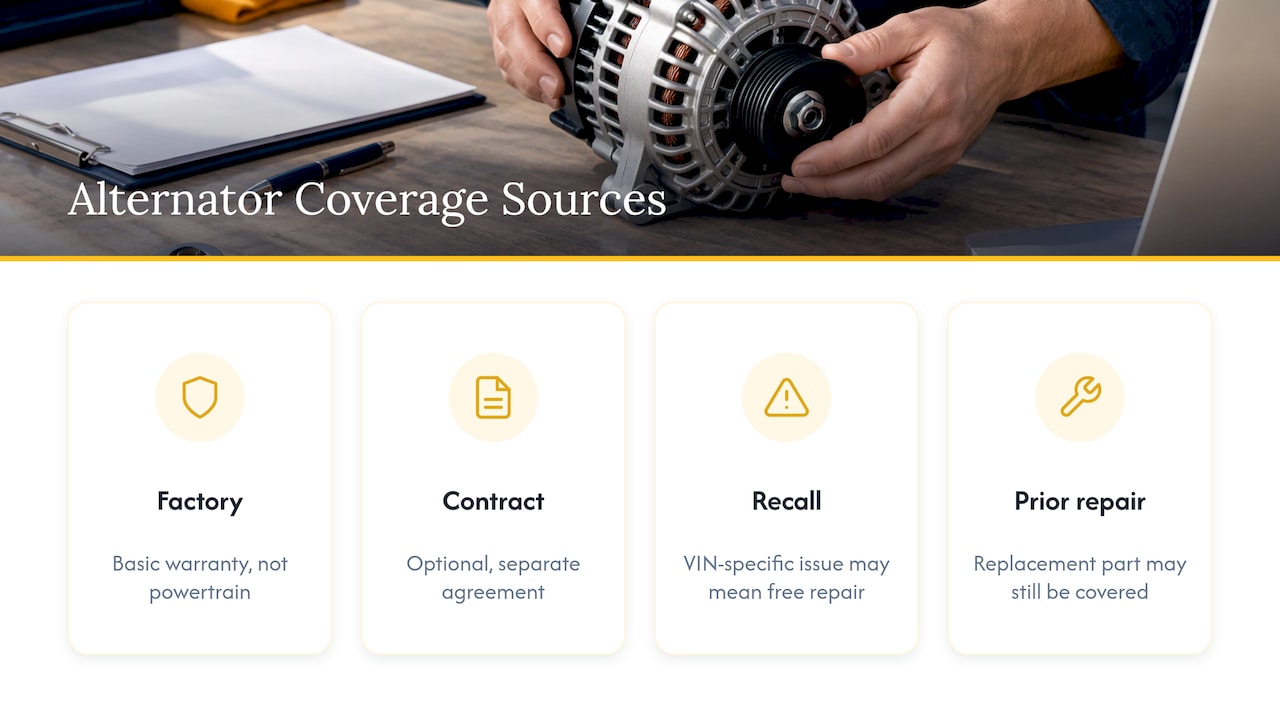
Before you call anyone, find out which of these you actually have. Mixing them up is the most common reason people think they are covered when they are not.
1. The factory warranty. A manufacturer warranty comes with the vehicle. Endurance’s guide explains that a new car’s alternator is typically covered by the basic limited warranty as an electrical-system component, not by the powertrain warranty. Volkswagen’s published component chart is a concrete example: it lists the alternator as a replace-only item, 6 years or 72,000 miles on 2018 to 2019 gas models and 3 years or 36,000 miles on 2009 to 2017 models. Other manufacturers set their own terms, so read your own booklet.
2. A vehicle service contract. This is what people call an extended warranty. The FTC treats it as a separate, optional agreement you buy, not part of the vehicle’s warranty, as DriveOn Protection’s guide summarizes. Many contracts list the alternator, voltage regulator and starter as covered electrical parts, but the contract itself decides.
3. A recall or campaign. If a specific alternator issue affects your VIN, the repair may be free regardless of age or mileage. Check your VIN with the manufacturer or NHTSA before paying for anything.
4. A warranty on an earlier repair. If a shop or parts seller replaced the alternator before, that part may still be covered. This is the one most owners forget, and it is often the most valuable.
The warranty that comes with the replacement part is the one you control, because you choose it when you buy.
What each type usually pays for
Coverage means very different things depending on the paper. A quick comparison:
| Coverage type | Typically pays for | Usually requires |
|---|---|---|
| Factory basic warranty | Repair or replacement of the alternator within the time and mileage limit | Dealer or authorized repair, no excluded damage |
| Vehicle service contract | Covered part plus labor at a set labor rate | Authorization number before work, paid invoice, claim filed on time |
| Replacement-part warranty | The replacement part, sometimes labor | Proof of purchase, correct installation, a confirmed part failure |
| Recall or campaign | The specific repair named in the notice | A matching VIN |
Two details cause most of the surprises. First, some contracts reimburse labor using a published labor guide instead of what your shop charged. A sample service contract pays labor on a nationally recognized labor guide and lets the administrator choose new, remanufactured, exchanged or used parts. Second, the same sample says repairs must be authorized first. Emergency work done without authorization is reimbursable only if it is reported by the next business day and costs no more than $250.
Why the diagnosis decides the claim
An alternator claim is really two questions: what failed, and which written coverage applies. A dim battery light does not answer either. It can point to a weak battery, a slipping belt, a bad cable, a blown fuse, a wiring fault, a parasitic draw or a control-module problem. DriveOn Protection advises getting a written diagnosis that names the failed component before you authorize a replacement, because coverage follows the diagnosed part and its cause, not the symptom.
This matters for your wallet too. If the real fault is a belt tensioner or a ground cable, a new alternator will not fix it and the replacement-part warranty will not pay for the original problem. We walk through that in our guide to alternators that keep failing, and in the three most common causes of alternator failure. If your symptoms are dimming lights or a battery warning, the 13 to 14.5 volt charging checks give you numbers to bring to the shop.

What typically voids or limits alternator coverage
The phrase “voided warranty” gets used loosely. In practice, a claim is denied because the failure falls under a listed exclusion. Written agreements we looked at share a pattern.
A 2017 service agreement excludes collision, vandalism, neglect, abuse, fire, flood, corrosion, incorrect installation, improper repairs, normal wear and tear, and any repair not authorized before work begins. It also says the customer pays disassembly costs if the breakdown turns out not to be covered. The Volkswagen chart above excludes damage from modifying the electrical system or from improper operation.
Translated into the mistakes owners actually make:
- Installing before diagnosing. Replacing the alternator when the battery, belt or wiring is at fault, then claiming the part when the same symptom returns.
- Skipping the battery check. A battery that is deeply discharged or failing makes the alternator work hard to recharge it. Test or replace the battery with the alternator so the new part is not asked to do the impossible.
- Loose, worn or misaligned belts and tensioners. A slipping or overtightened belt can cause noise and early wear. Our walkthroughs on alternator whine traced to a tensioner and bearing noise show what to inspect first.
- Electrical additions and heavy loads. Adding high-draw accessories such as lighting, audio or winches without upgrading the charging system can fall under electrical modification exclusions.
- Poor connections. A loose or corroded output cable, or a bad ground, creates heat and voltage problems. Heat is also one of the things to check before blaming the part, as in our alternator overheating guide.
- Working before authorization. For service contracts, this alone can sink an otherwise valid claim.
A safety note: disconnect the negative battery cable before removing or installing an alternator, and keep the output terminal from touching metal. If you are not comfortable with that, have a qualified mechanic do the installation and keep the invoice, which you will need for any claim.
Will using a remanufactured part void my vehicle warranty?
No. Federal law gives you protection here. Under the Magnuson-Moss Warranty Act, a manufacturer cannot condition coverage on using brand-named parts or services (section 2302©). If a remanufactured alternator is installed correctly, the vehicle warranty is not voided simply because the part did not come from the dealer. A denial has to rest on the part or the installation actually causing the failure.
What the law requires a written warranty to say
Federal rules make warranties easier to compare. The Magnuson-Moss Warranty Act requires written warranties on consumer products to disclose their terms in simple, readily understood language and to be designated either “full” or “limited.” A full warranty must fix defects within a reasonable time at no charge, and after a reasonable number of failed attempts the consumer can choose a refund or replacement. A limited warranty does not carry those guarantees, so read what it promises.
The FTC’s warranty rules in 16 CFR Part 701 say a written warranty on a consumer product must state, in a single document:
- who is covered,
- which parts are covered and which are excluded,
- what the remedy is and who pays for it,
- when coverage starts and how long it lasts,
- the step-by-step process for making a claim.
That list is a ready-made checklist. If a warranty you are reading leaves one of those out, ask the seller to put it in writing before you order.
How to compare alternator warranties
Use the same five questions on every part, whether it is new, remanufactured or used.
- How long, and from when? Coverage may start at purchase or at installation. Some warranties are measured in time, some in miles, some in both.
- Parts only, or labor too? Alternator replacement is often mostly labor. Athena Auto Protection’s 2026 guide puts typical replacement at $400 to $700 for most domestic compact and midsize sedans, $500 to $900 for trucks and larger SUVs, and $700 to $1,400 for European vehicles. Check whether the warranty pays any of the labor.
- What is excluded? Look for installation, modification, wear and unauthorized-repair language, as listed above. The serpentine belt that drives the alternator is a wear item and is excluded on all plans in that same guide.
- What is the claim process? Look for who you call, what documents you need, and the deadline for filing.
- Does it transfer? This is easy to overlook. Capital One’s used-car guide notes that 24-month parts warranties from GM, Ford and Stellantis end with the owner who paid for the repair, while Mercedes-Benz’s is transferable. If you plan to sell soon, or you are buying a used car with a recently replaced alternator, ask in writing what actually passes on.
What about a lifetime alternator warranty?
“Lifetime” is a headline, and the written terms define it. Ask whose lifetime it means (yours as the original buyer, or the vehicle’s), whether it covers parts, labor or both, and what the claim requires. The five questions above work on any of them. The same logic applies to warranty rights in other fields: this explainer on warranty rights after a repair shows how coverage on installed work depends on the written terms and on how the work was done.
If you want a broader look at fit, amperage and warranty together, our guide on how to choose an alternator covers the rest of the buying decision.
Who benefits most from a good replacement-part warranty
The reader groups we serve each use the warranty differently.
- Vehicle owners and DIYers. You pay for the part and possibly the labor once. A clear warranty on the part protects that spend if the unit fails.
- Mechanics. A comeback on a repair costs you time and reputation. A part with documented terms and a simple claim path makes that conversation easier.
- Fleet managers. Repeat failures across many vehicles add up. Warranty terms that are consistent across units make budgeting and recordkeeping simpler.
- Classic and restoration owners. Older vehicles are often outside any factory coverage, so the replacement-part warranty may be the only coverage you have.
Perspective
Most alternator warranty disputes start before the part is ordered. The owner replaces a part to match a symptom, the symptom comes back, and now there is a paper trail that does not help anyone. The best warranty is the one you never need because the diagnosis was right the first time.
That is why we rebuild every alternator and starter with all-new components and test it to meet or exceed OEM specifications before it ships. A rebuilt unit that is built and tested this way is meant to be a dependable choice, not a compromise, and it comes backed by a warranty. Our parts are rebuilt in the USA for cars, trucks, vans, SUVs and specialty vehicles across all major brands, and we ship the same day for urgent repairs.
Our advice is simple: get the failed component named in writing, read the warranty on the replacement part before you pay, keep your invoice, and install the part with the battery and belt checked. Do that, and you have given any warranty the best chance to do its job.
Ismael
Get a rebuilt alternator or starter with a warranty
If your diagnosis points to the alternator, our rebuilt alternators are rebuilt with new components, tested to OEM specifications and backed by warranty. They are available for all major vehicle brands and ship the same day for urgent repairs. For a no-crank condition, see our rebuilt starters, and read the starter warranty guide before you authorize any repair.
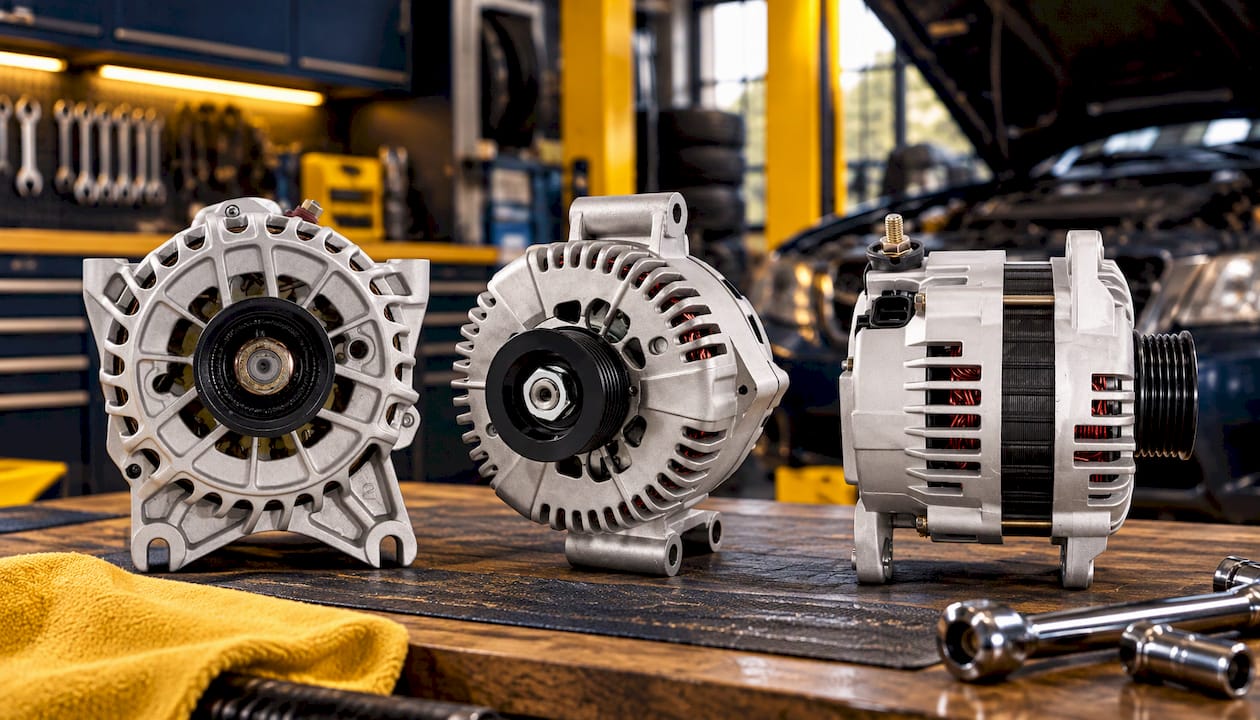
If you already know your vehicle, you can go straight to a listing such as the alternator for the 2002 to 2006 Nissan Altima. Our returns policy explains how returns work.
FAQ
Is an alternator covered under my car’s warranty?
Often yes, if the vehicle is still within its basic warranty. The alternator is typically an electrical component under the basic coverage, not the powertrain warranty. Check your warranty booklet or the manufacturer’s component chart for the exact time and mileage limit.
Does a service contract cover the alternator?
Many list the alternator, voltage regulator and starter as covered electrical parts, but you need to read your contract. Most require an authorization number before any work starts, plus a paid invoice and your VIN when you file the claim. Repairs done without authorization are commonly denied.
What do I need to make an alternator warranty claim?
Start with proof of purchase, a written diagnosis naming the failed component, and the installation invoice. Then follow the claim steps in the warranty document. Federal rules say that document must spell those steps out.
Can the way I installed the alternator void the warranty?
Incorrect installation is a standard exclusion in written agreements, and so is electrical modification. Check the battery, belt, tensioner, cables and grounds first, and keep records of the work. Using a remanufactured part does not itself void your vehicle’s warranty.
Does the warranty on a replacement alternator transfer to the next owner?
It depends on the terms. Some manufacturers’ parts warranties end with the owner who paid for the repair, while others transfer. Ask for the transfer terms in writing before you rely on it when buying or selling a used car.
Sources
- Alternator Warranty Coverage Guide, DriveOn Protection
- Warranty Coverage by Component Quick Reference (NHTSA-hosted PDF)
- What’s an Alternator and Does My Warranty Cover It?, Endurance Warranty
- Does Extended Warranty Cover Alternator Replacement?, Athena Auto Protection
- Your Used Car May Have More Warranties Than You Realize, Capital One
- Powertrain Plus sample service contract
- 2017 vehicle service agreement
- U.S. Code Title 15, Magnuson-Moss Warranty Act
- 16 CFR Part 701, FTC warranty rules (2025 edition)
- Warranty rights after a repair