Cart
0
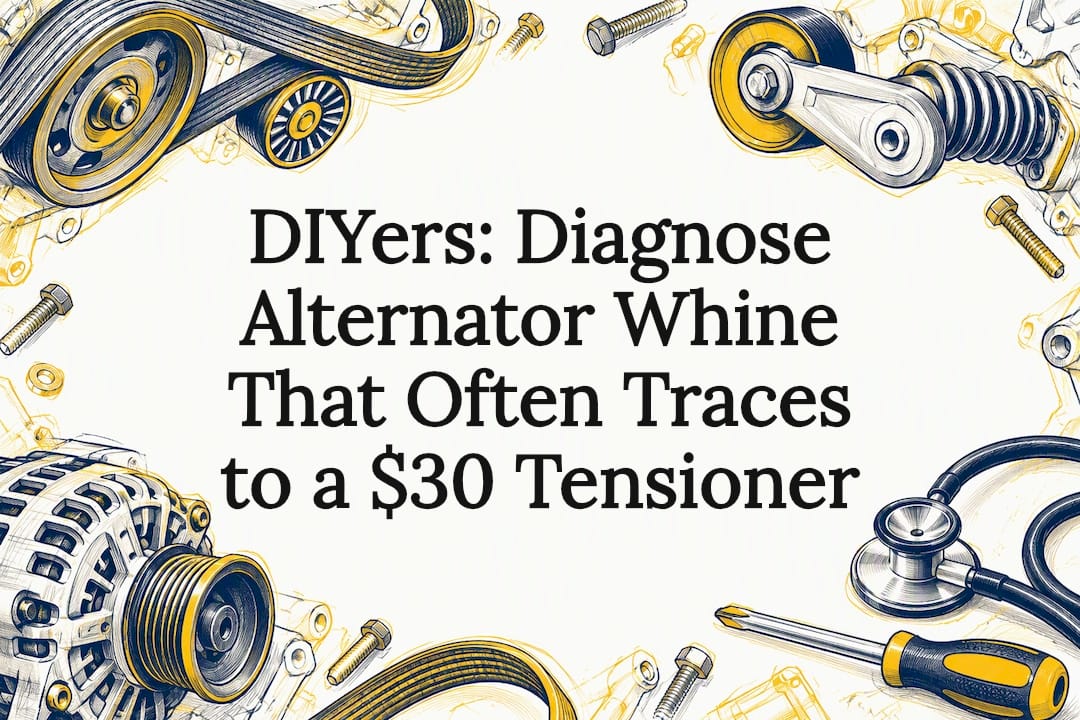
A high-pitched alternator whining noise most commonly comes from worn bearings or a slipping belt. Confirm which one before you spend money: if the pitch tracks engine RPM, suspect the belt or pulley first. If you also see a battery warning light or charging voltage outside the normal 13.8 to 14.5 volt range. Stop driving and get the charging system checked right away.
TL;DR:
- Worn alternator bearings are the most common cause of whining noise and typically worsen quickly once failure begins, often requiring replacement.
- Electrical whine caused by failing diodes or rectifiers can create a steady tone that changes with electrical loads like headlights or air conditioning.
- Belt and tensioner issues frequently mimic alternator failure and can often be identified through simple tests like water spray or belt-off spin, saving unnecessary part replacements.
- A proper diagnosis involves checking voltage levels, noise behavior at different loads, and visual belt inspections before replacing the alternator.
- Opt for tested remanufactured alternators built to OEM standards, as they target failure points and reduce risk of quick repeat failures.
Table of Contents
- What the whining sounds like and how to tell mechanical from electrical noise
- Most common causes, ordered by likelihood
- Step-by-step diagnostic workflow (safe tests you can do at home or the garage)
- Short-term fixes, safety guidance, and driving risk triage
- Repair options and decision factors: bearing service vs. rebuild vs. replacement
- How Rebuild Masters approaches alternator whine at the source
- What years of diagnosing this noise actually teaches you
- Getting the right replacement without guessing on fit
- Sources
- FAQ
What the whining sounds like and how to tell mechanical from electrical noise
Mechanical bearing noise is coarse and rumbling, almost gravelly, and it gets louder as engine RPM climbs. You can usually feel it as a vibration in the alternator housing if you touch it carefully with the engine off, or confirm it with a mechanic’s stethoscope or a long screwdriver held against the case while the engine idles. A coarse rumble that transmits through the housing points to a bearing problem, while a pure, high-pitched tone that does not produce that tactile buzz usually points somewhere else.
Electrical whine behaves differently. It tends to be a steady, almost musical tone, and it often shows up through the car’s speakers before you even notice it under the hood. It can change or pulse when you turn headlights, the rear defroster, or the air conditioning compressor on and off, because those loads change how hard the alternator’s internal electronics are working.
A short checklist helps separate the two before you touch a wrench:
- Compare the noise at idle versus revving the engine in park: RPM-linked noise favors a belt or bearing issue.
- Turn on the headlights, blower motor, and rear defroster, then listen for a change: load-linked noise favors an electrical fault.
- Listen through the radio with it off and the volume at zero to catch electrical whine that induces itself into the audio circuit.
- Watch the battery or charging light on the dash for flickering or staying lit.
Most common causes, ordered by likelihood
Alternator whine has a short list of usual suspects, and they are not equally common. Starting with the most frequent helps you avoid replacing a part that was never the problem.

Worn bearings sit at the top of that list. The alternator shaft spins on one or two bearings, and as they wear they develop play and start to rumble, then whine as the wear worsens. This noise almost always tracks engine speed, and it tends to get worse quickly once it starts, because a bearing under stress generates heat that accelerates its own failure. Left alone, a failed bearing can seize the pulley or let the rotor contact the stator, which usually means the whole unit needs replacing rather than a simple bearing swap.
Failing diodes, a bad rectifier, or worn brushes cause the electrical version of the noise. The alternator converts AC current to the DC your car’s electronics need, and a cracked diode or a worn rectifier lets some of that AC ripple through uncorrected. That ripple often comes out as a tone through the stereo speakers rather than a sound you hear directly from the engine bay. Simple voltage checks can sometimes miss an intermittent diode leak, so confirming this cause properly may call for checking AC ripple with an oscilloscope rather than a basic multimeter test.
Belt and tensioner problems are the cause most often overlooked, and they mimic alternator failure closely enough to send people shopping for a new alternator when the real problem is a $30 tensioner. A glazed or stretched belt slips under load and squeals or whines, a weak tensioner lets the belt flutter, and pulley misalignment forces the belt to ride at an angle that increases friction and heat. Industry guidance points to this as a recurring failure chain: a weak tensioner or misaligned pulley wears out alternator bearings prematurely, which is why inspecting the whole drive system before condemning the alternator saves both money and repeat failures. DIYers often zero in on the alternator alone and skip the pulleys, tensioner, and belt condition, which leads to a fix that does not hold.
High-output alternators are worth a mention because their normal operating noise gets mistaken for a fault. Units built for heavy electrical loads, like those feeding aftermarket stereos or winch systems, spin their internal fans and rotors harder and produce more baseline whir than a stock alternator. If that whine has been present since installation and does not change or worsen over time, it may simply be how that unit sounds under load.
A belt-off spin test tells you almost everything about whether the noise lives inside the alternator or in the drive system around it. With the belt removed and the alternator disconnected, spinning the pulley by hand should feel smooth and quiet: any grinding, roughness, or excessive play at that point isolates the fault to the alternator itself.

Step-by-step diagnostic workflow (safe tests you can do at home or the garage)
This sequence moves from safest and cheapest to most involved, and it is built to rule out the belt and drive system before you spend money on an alternator.
- Turn the engine off and inspect visually first. Check the belt for cracking, glazing, or fraying, and look at the tensioner and pulleys for wobble, corrosion, or visible misalignment.
- Run the spray-belt test. With the engine running and the hood open, lightly mist water on the belt. If the whine changes or briefly quiets, the belt or tensioning system is the likely cause rather than the alternator itself.
- Do the belt-off spin test. Remove the belt and spin the alternator pulley by hand. Roughness, grinding, or noticeable play means the bearings are the problem; a smooth, quiet spin clears the alternator and points back to the belt or pulleys.
- Localize the sound with a stethoscope or screwdriver. With the engine idling and the belt reinstalled, touch the tool to the alternator case, the tensioner, and the idler pulley in turn to find which component actually transmits the noise.
- Check charging voltage at idle and under load. A healthy charging system should read in the 13.8 to 14.5 volt range; anything lower with the engine running suggests the alternator is not charging adequately.
- Add electrical load and watch the voltage. Turn on headlights, the blower, and the rear defroster together and watch whether voltage sags further or the whine intensifies, which points toward a diode, rectifier, or brush issue.
- Match your results to a decision. A positive spray-belt test or visible belt wear means fix the belt and tensioner. A rough belt-off spin or persistent whine with no belt installed means the alternator itself needs service or replacement.
Pro Tip: Write down the exact RPM and load condition where the noise changes before you call a shop. That detail alone often cuts diagnostic time in half.
Short-term fixes, safety guidance, and driving risk triage
Some fixes buy you time to get to a shop; others do not, and driving on them risks a stranded car or worse. A loose belt can sometimes be re-tensioned temporarily if the tensioner still has adjustment left, and a glazed belt that has not started slipping badly can hold for a short drive if you avoid running the air conditioning, defroster, and headlights all at once. None of that solves a worn bearing or a failing diode, though, and pushing those further usually ends in a dead battery or a seized pulley at an inconvenient time.
Certain signs mean you should stop driving rather than manage around the noise:
- Charging voltage that fluctuates or drops noticeably under load rather than holding steady.
- A battery or charging warning light that stays lit or flickers, which AAA notes means the car may be running on stored battery power alone.
- Any smoke, burning odor, or a sudden change in the pitch or volume of the noise.
- A belt that visibly slips, smokes, or has started to shred at the edges.
Pro Tip: If the battery light comes on while you’re driving, turn off everything you don’t need (stereo, climate control, extra lights) to stretch the battery’s remaining charge until you can pull over safely.
If your tests point cleanly to a belt or tensioner problem, scheduling a repair within a few days is usually reasonable. If they point to a bearing or electrical fault inside the alternator, especially alongside a lit warning light, treat replacement as immediate rather than something to put off.
Repair options and decision factors: bearing service vs. rebuild vs. replacement
Bearing-only service makes sense on some alternator designs, but it is not always practical. Pressing out old bearings and pressing in new ones requires the right tools and a case that is not damaged from the failure, and on many compact alternators the labor involved gets close to the cost of a rebuilt unit anyway. Once bearings have failed badly enough to let the rotor contact the stator, a bearing swap alone will not fix the underlying damage.
A remanufactured alternator rebuild typically replaces the bearings, brushes, diodes, and rectifier as a set, then tests the finished unit against OEM output specifications rather than just reassembling the original parts. That is different from buying a bargain aftermarket unit with no testing claims behind it, which is where a lot of repeat failures originate. Checking whether a rebuild is tested to OEM specifications and backed by a warranty before buying separates a durable fix from another round of the same noise a year later.
Belt deflection matters here too. Service guidance points to roughly a quarter to a half inch of deflection between pulleys on many vehicles; a belt with incorrect tension can shorten pulley and bearing life even on a freshly rebuilt alternator.
Before buying a replacement, confirm:
- The amperage rating matches your vehicle’s original alternator and electrical demands.
- The listing states the unit is tested to OEM specifications, not just visually inspected.
- A warranty and a clear turnaround or shipping timeline are listed, since a dead alternator rarely waits for slow shipping.
How Rebuild Masters approaches alternator whine at the source
Rebuild Masters builds its remanufactured alternators and starters around the failure points covered above rather than just swapping a housing. That matters because a rebuild that skips bearings, brushes, or the rectifier can hand a buyer the same whine a few months later.
- Each unit is rigorously tested and rebuilt to meet or exceed OEM specifications, which targets the bearing, diode, and brush wear points that cause whining in the first place.
- Rebuild Masters focuses specifically on remanufactured alternators and starters, rather than treating them as one line among many unrelated parts.
- Same-day shipping is available for urgent replacements, which matters when a car is off the road.
Three current listings illustrate how specific the fitment matching gets: the 11195 Alternator for 09-12 Toyota Corolla | 07-09 Toyota Camry | 08-15 Scion XB, the 11385 Alternator for 09-11 Toyota Corolla | 09-10 Toyota Matrix | 08-14 Scion XD, and the 11537 Alternator for 13-15 Acura ILX | 12-13 Honda Civic | 16-18 Honda HR-V. Each covers a specific run of shared-platform vehicles rather than a broad, loosely matched fit.
What years of diagnosing this noise actually teaches you
Most alternator whine I have seen misdiagnosed turns out to be a tensioner or pulley problem wearing a good alternator down, not the alternator failing on its own. Check the belt and tensioner before you assume the worst.
When you call a shop, give them the voltage readings, whether the noise tracks RPM or electrical load, and when the belt was last serviced. That alone usually cuts their diagnostic time significantly.
For the common case where bearings or electronics have genuinely failed, a tested remanufactured alternator is usually the sensible call over a bargain aftermarket unit with no testing behind it.
— Ismael
Getting the right replacement without guessing on fit
Once your tests point to the alternator itself, the part you buy matters as much as the diagnosis. Rebuild Masters rebuilds each alternator to meet or exceed OEM specifications and backs it with a warranty, with same-day shipping so a dead alternator does not keep your car off the road longer than it has to.

- Check your vehicle’s year, make, and model against the listing before ordering, since alternators are not interchangeable across trims with different electrical loads.
- Browse Rebuilt Alternators for common fits, including the Corolla, Camry, Scion, Civic, and HR-V listings covered above.
- If your starter is original-equipment age as well, Rebuilt Starters covers the same testing and warranty approach.
- Review the returns policy before ordering so you know the warranty terms if fitment or performance is ever an issue.
Confirm the amperage rating matches your original unit, then place the order and get the correct part shipped the same day.
Sources
- Seek the squeak and reveal the squeal — Vehicleservicepros
- When good alternators go bad and why — Haynes Manuals North America
- A guide to automotive belts and hoses — AAA
FAQ
How long will an alternator last after it starts whining?
There is no fixed timeline, since it depends on whether the cause is a worn bearing, a failing diode, or a belt problem, and how hard the vehicle is driven afterward. A bearing-related whine tends to worsen quickly and can lead to seizure within days to weeks, so getting it tested rather than waiting is the safer approach.
How do I get rid of alternator whine?
First confirm the source with a belt-off spin test and a spray-belt test, since a large share of alternator whine actually traces back to a worn belt or weak tensioner rather than the alternator itself. If the alternator tests rough or the charging voltage falls below the healthy 13.8 to 14.5 volt range, replacing or rebuilding the unit resolves it permanently.
Can I spray WD-40 on an alternator?
Spraying WD-40 or any lubricant directly on an alternator is not a recommended fix, since it can contaminate the bearings, belt, or internal electronics rather than solve the underlying wear. The water-spray test used to diagnose belt slip is a diagnostic check, not a lubricant application, and should not be confused with treating the noise.
What are the first signs of an alternator going bad?
Early signs include a whining or growling noise that changes with engine speed, dimming or flickering headlights, and a battery or charging warning light on the dash. A battery light that stays on or flickers signals the car may be running on stored battery power, which warrants prompt attention rather than delay.