Cart
0
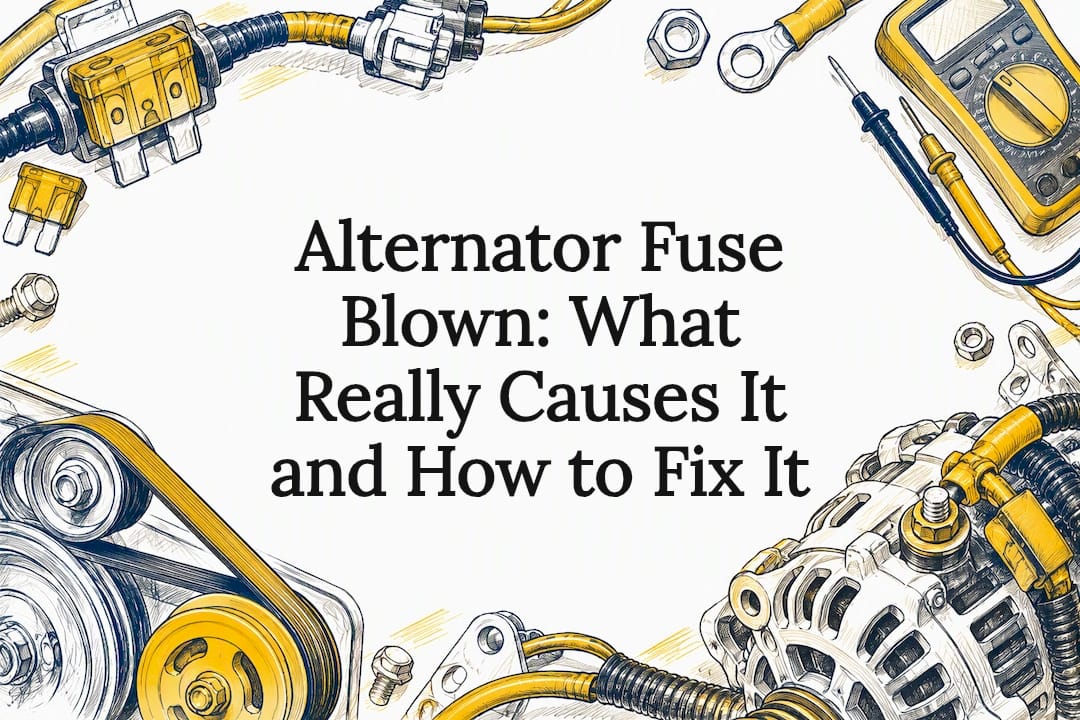
If your alternator fuse keeps blowing, the likely culprit is an internal alternator fault (shorted diodes or stator) or a wiring short on the B+ circuit, sometimes a corroded ground. Stop replacing fuses blindly: disconnect the battery, pull the fuse, and run a charging voltage and voltage-drop check or bench-test the alternator before installing another one.
TL;DR:
- Repeated fuse blowouts usually stem from internal alternator faults, like shorted diodes or stator, or wiring issues such as chafed cables or corroded grounds.
- Signs of a blown fuse often mimic battery problems, but voltage drop and ripple tests can confirm if internal alternator failure is causing excessive current.
- Proper diagnostics involve checking charging voltage, voltage drop, and ripple before replacing the alternator or wiring components.
- Using a bench-tested remanufactured alternator with verified internal components reduces the risk of repeat fuse blowing compared to untested units.
- Visual inspections, disconnecting accessories, and employing a diagnostic fused jumper help isolate external causes and prevent unnecessary replacement costs.
Table of Contents
- What commonly makes an alternator fuse blow repeatedly
- How to recognize a blown alternator fuse vs. other charging problems
- How to test charging voltage, voltage drop, and ripple
- Quick isolation checklist before replacing the fuse
- Repair choices: wiring, fusible link, or new alternator
- Why a bench-tested remanufactured alternator lowers the risk of repeat blowouts
- A practical troubleshooting order worth following
- Get a tested replacement instead of guessing twice
- Sources
- FAQ
What commonly makes an alternator fuse blow repeatedly
A fuse blows because too much current flows through it, and in a charging system that almost always traces back to one of a handful of causes. Finding which one applies determines whether you need a wrench, a crimper, or a new alternator.
- Internal alternator failure: Shorted rectifier diodes or a shorted stator winding can push excess current back into the B+ circuit, overloading the fuse every time it is replaced.
- External shorts or aftermarket taps: A chafed wire or an improperly spliced accessory line tapped into the alternator’s B+ cable creates a direct path to ground.
- High-resistance or corroded connections: A loose or corroded ground strap or battery terminal forces current to find alternate paths, generating heat that eventually pops the fuse.
- Reversed polarity or bad jump-starts: Connecting jumper cables backward, or recent electrical work that disturbed a connector, can damage the rectifier instantly and leave a fuse that blows the moment the circuit is live.
A Fluke guide to automotive electrical troubleshooting notes that a blown fuse is usually a symptom rather than the root problem, and that reversed polarity, diode shorts, or corroded high-resistance connections are the common triggers. Swapping in a new fuse without finding which of these applies almost always leads to another blown fuse within minutes.
How to recognize a blown alternator fuse vs. other charging problems
A blown alternator fuse often looks like a dying battery at first, which is why so many people replace the wrong part. A few clues separate the two.
- Dashboard warning signs: A lit battery icon, dimming or flickering headlights, and a battery that drains fast after a jump-start point to a charging-circuit problem rather than a dead cell.
- Stalling after a jump-start: An engine that starts briefly and then dies again suggests the alternator is not sending current back to the battery at all.
- Physical evidence: A melted fusible link, a burned-wire smell near the engine bay, or a fuse that blows again the moment you reconnect the B+ wire all point to a short rather than normal wear.
- The voltage mismatch clue: If voltage reads normal at the alternator but low at the battery, the fuse itself is probably fine and the wiring between the two is the problem.
These symptoms line up with what AAA’s guidance on alternator failure describes: a battery warning light, dimming or flickering lights, a burning-wire smell, and stalling after a jump-start are the typical signs of a failing charging system, and they overlap enough with battery problems that a meter is the only reliable way to tell them apart. A related overview of alternator failure symptoms covers much the same ground from a shop’s perspective.
How to test charging voltage, voltage drop, and ripple
Before touching any wiring, remove the fuse and disconnect the battery’s negative terminal. Use insulated tools, and never work on a live B+ circuit with bare hands near metal.
- Charging voltage test: With the engine running, a healthy alternator should read between 13 and 14.5 volts at the battery. Compare that reading at the alternator’s B+ terminal against the battery post: a noticeable gap between the two means the wiring in between is the problem, not the alternator itself.
- Voltage-drop test: Probe the positive and ground circuits while the engine runs. A positive-side drop around 0.3 volts and a ground-side drop of 0.2 volts or less are acceptable; anything higher signals corrosion or a damaged cable that is likely overheating the fuse.
- Ripple (AC) test: Set the multimeter to AC volts and measure at the alternator’s B+ terminal or battery positive. Ripple of 50 mV AC or less at idle is normal, while readings of 0.30 to 0.50 volts AC or higher point to a failing rectifier diode or stator. That single number often settles the diagnosis faster than any visual inspection.
- Bench isolation: Unplug the alternator’s harness and see if the fuse still blows with the engine off and the circuit otherwise intact. If it stops blowing, the alternator’s internals are the likely cause; if it keeps blowing, look at the wiring and accessory taps instead.
Pro Tip: Log the MAX ripple reading during a quick snap of the throttle. Intermittent diode failures sometimes only show up under a momentary load spike, not at idle.
If you don’t own a multimeter, the readings seem inconsistent, or you find scorched wiring near the engine bay, stop here and have a shop finish the diagnosis. Guessing at this stage usually costs more than the diagnostic fee.

Quick isolation checklist before replacing the fuse
Run through these steps in order before you put in another fuse. Each one eliminates a common external cause.
- Inspect visually for chafed insulation, melted wire jackets, or aftermarket wiring spliced into the B+ cable.
- Clean and tighten the battery terminals and every engine-to-chassis ground strap, then retest voltage drop.
- Disconnect high-current accessories, such as amplifiers, auxiliary lights, or a winch, and see if the fuse survives without them.
- Use a fused jumper or a resettable circuit breaker in place of a fuse while testing, so a short doesn’t cost you another part.
- Compare the two outcomes: if the fuse blows with the alternator unplugged, the wiring or an accessory tap is at fault; if it only blows with the alternator connected, the alternator itself is the suspect.
Pro Tip: A diagnostic fused jumper or circuit breaker saves you from burning through a box of fuses while you track down an intermittent short, and it reduces fire risk while you work.
Repair choices: wiring, fusible link, or new alternator
Once testing points to a cause, the fix usually falls into one of three categories.
- Repair the wiring: Replace any damaged section of the gauge-matched wire, use proper crimp connectors with heat-shrink tubing, and route the new wire away from heat and moving parts.
- Replace the fusible link or fuse: Only after the root cause is fixed, and only with the OEM-specified amperage and wire gauge, never a higher rating to “stop it from blowing.”
- Replace the alternator: Warranted when ripple exceeds the 0.30 to 0.50 volt AC threshold, diode pulses are missing, or a bench test confirms an internal short.
- Consider a remanufactured, bench-tested alternator as a cost-effective swap, and ask the seller for warranty terms and test records before buying.
- Expect cost to vary with the alternator’s brand and type, the labor time needed for diagnosis, and how hard the unit is to access on your particular vehicle.
Why a bench-tested remanufactured alternator lowers the risk of repeat blowouts
An alternator that still has a marginal diode or a failing stator will blow fuses again even after you fix the wiring. Remanufactured alternators are made with new components to meet or exceed OEM specifications and are bench-tested before shipping, which is the same kind of diode, ripple, and load verification you’d want to see from any shop doing the repair. Before buying any replacement, ask for those test records and the warranty terms in writing. Fitments include the Toyota Tacoma alternator and the Ford F-Series and related truck alternator on the rebuilt alternators page.

A practical troubleshooting order worth following
I’d work through this in a fixed sequence: safety first, then a visual check, then charging voltage at both the alternator and battery, then voltage drop, then ripple, then isolate the alternator by unplugging its harness. Only repair or replace once that order points clearly to one part. Stop and call a shop if you lack a meter, the ripple test shows a clear diode fault, or the wiring looks unsafe to handle. Replacing fuse after fuse without this sequence wastes money and risks a fire.
— Ismael
Get a tested replacement instead of guessing twice
A bench-tested alternator with new internal components and a backing warranty removes the guesswork that comes with swapping in another unknown part. Remanufactured alternators are made in the USA with new components, tested before shipping, and same-day shipping is offered for urgent needs.

- Check the Toyota Tacoma alternator or the 05-07 Toyota Tacoma alternator for that platform.
- Ford truck and SUV owners can match fitment on the Ford F-Series, Bronco, Explorer, and Ranger alternator page.
- Browse the full rebuilt alternators lineup or the rebuilt starters lineup and contact support to confirm fitment before you order.
FAQ
How much does it cost to replace an alternator fuse?
The fuse or fusible link itself is inexpensive, typically a few dollars for the part. The real cost comes from diagnosing why it blew, which can involve labor time for voltage, voltage-drop, and ripple testing, plus the price of a replacement alternator if testing confirms an internal fault.
Do alternators just go out suddenly?
An alternator can fail suddenly, especially after a reversed-polarity jump-start or a sudden diode short, but it more often degrades gradually with symptoms like dimming lights or a battery warning before it fails completely. A ripple reading above 0.30 to 0.50 volts AC often shows up before a total failure.
What does a bad alternator fuse look like?
A blown fuse usually shows a visibly broken or discolored metal strip inside a clear housing, while a fusible link may look melted, swollen, or charred with a burned-wire smell nearby. Repeated blowing on reinstallation, rather than the fuse’s appearance alone, is the stronger sign of an underlying short.
Can a fuse stop the alternator from charging?
Yes, if the alternator’s main fuse or fusible link is blown, the charging circuit is broken and the battery will not receive current, even if the alternator itself is healthy. Checking for 13 to 14.5 volts at the battery with the engine running confirms whether the circuit is complete.
Recommended
- The Heart of Your Vehicle’s Electrical System: Understanding the Critical Importance of Your Alternator
- Everything You Need to Know About Automotive Alternators: Signs of Failure and Helpful Tips
- Alternator Rebuilding Explained: How the Process Works
- Remanufactured Alternators | Buy Rebuilt Alternators