Cart
0
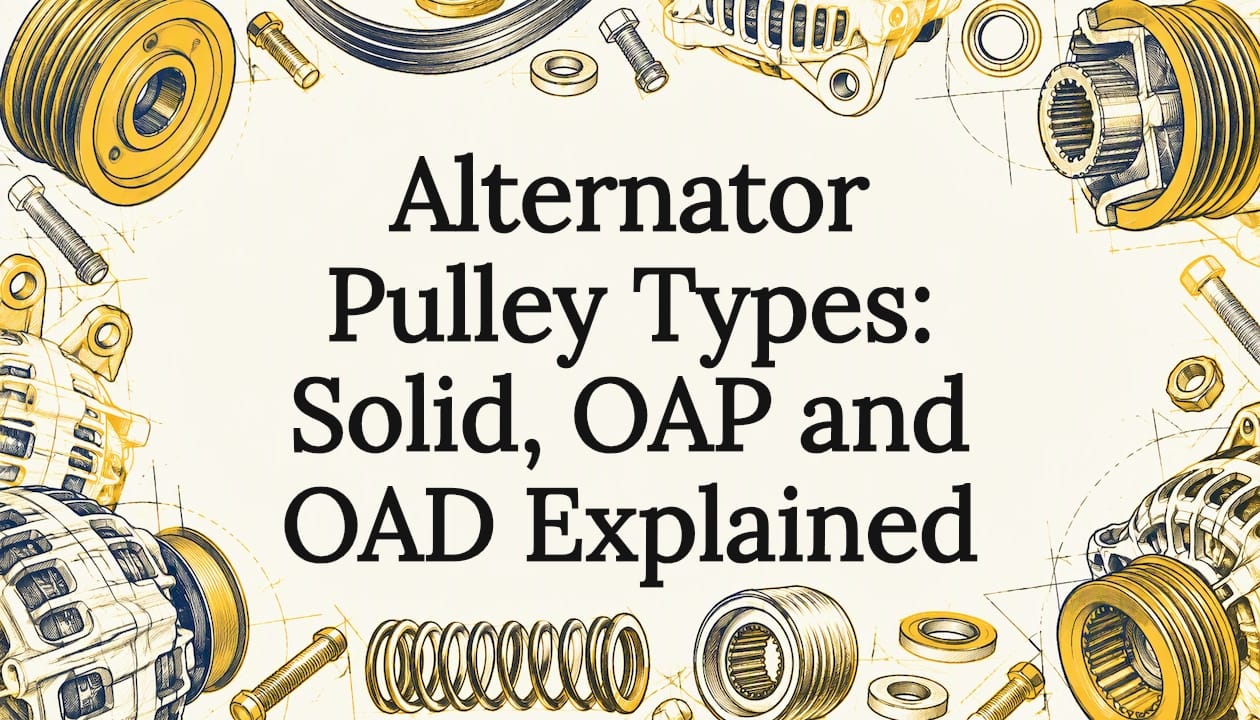
There are three alternator pulley types: a solid pulley, an overrunning alternator pulley (OAP) with a one-way clutch, and an overrunning alternator decoupler (OAD) that adds a torsion spring to the clutch. Your vehicle was engineered for one of them, and the safest replacement is the same type, with the same groove profile and size. This guide shows how each one works, how to tell which one you have, what to match when you buy, and what a failing pulley sounds like.
TL;DR
- Solid pulley: one piece of metal locked to the alternator shaft. It is simple, but it passes every speed change in the engine straight into the alternator.
- OAP: has a one-way clutch, so the alternator can keep spinning when the engine suddenly slows down.
- OAD: has the clutch plus an internal torsion spring that also dampens belt-drive vibration.
- Identify yours by how it mounts (threaded on versus slid on and bolted), by the dust cap on the end, and by a belt-off hand spin test.
- Replace like with like. Match the type, rib count, diameter and shaft fit to your vehicle, not just to the alternator housing.
Table of Contents
- The three alternator pulley types at a glance
- Solid alternator pulleys
- Overrunning alternator pulleys (OAP)
- Overrunning alternator decoupler pulleys (OAD)
- How to tell which pulley you have
- Specs to match when you replace a pulley or alternator
- Can you swap one type for another?
- Symptoms of a worn or failing alternator pulley
- Pulley or whole alternator?
- Our perspective
- Get the right rebuilt alternator for your vehicle
- FAQ
- Sources
The three alternator pulley types at a glance
Every alternator has a pulley that takes power from the serpentine belt and turns the rotor inside. What differs is what sits between the belt groove and the shaft.
| Feature | Solid pulley | OAP (one-way clutch) | OAD (decoupler) |
|---|---|---|---|
| Internal parts | None, a single piece | One-way clutch | One-way clutch plus torsion spring |
| Freewheels when the engine slows | No | Yes | Yes |
| Dampens belt vibration | No | Limited to the clutch action | Yes, through the spring |
| Typical mounting | Slides on or press-fit, held by a large bolt | Threads onto the shaft | Threads onto the shaft |
| Serviceable on its own | Rarely needed | Often replaceable separately | Often replaceable separately |
The mounting and function rows follow trade reporting on decoupler pulley service: an OAP has a one-way clutch that lets the pulley freewheel when the engine suddenly decelerates, while an OAD adds a torsion spring that dampens belt-drive vibrations. Those special pulleys are engineered to reduce noise, vibration and harshness (NVH) and to extend alternator life.
Solid alternator pulleys
A solid pulley is exactly what it sounds like. The groove section and the hub are one piece, fixed to the shaft. When the crankshaft speeds up, the alternator speeds up with it. When the crankshaft slows, the alternator, which has its own spinning mass, is dragged down with it.
This was the standard design for decades and it still appears on many older vehicles and on some current ones. It has nothing inside that can wear out, which is its main strength. Its limit is mechanical: every sudden change in engine speed, such as a hard shift or a quick throttle lift, travels through the belt to the alternator and the tensioner.
On a solid pulley, trouble usually shows up elsewhere: a worn alternator bearing, a damaged groove, or a loose retaining bolt. If you hear a growl or whir from a vehicle with a solid pulley, our guide to diagnosing alternator bearing noise walks through how to separate bearing noise from belt noise.
Overrunning alternator pulleys (OAP)
The OAP puts a one-way clutch between the outer ring that carries the belt and the hub on the shaft. Under normal driving the clutch locks and the belt drives the alternator. When the engine slows quickly, the alternator rotor, which has momentum, can keep spinning faster than the belt, because the clutch lets it overrun.
Why that matters: the belt and tensioner no longer have to absorb the rotor’s momentum every time engine speed drops. That reduces the shock loads and the slap that can wear tensioners and belts over time.
You will see the terms “clutch pulley,” “freewheel pulley,” “one-way pulley” and “overrunning pulley” used for this style. They all describe the same idea.
Overrunning alternator decoupler pulleys (OAD)
The OAD does everything the OAP does, and adds a torsion spring between the outer ring and the clutch hub. The spring flexes as engine speed pulses, which is how it dampens belt-drive vibration. That matters most on engines with strong torque pulses, such as diesels and some low-cylinder-count or high-compression gasoline engines, where the crankshaft speed is anything but smooth.
The name “decoupler” comes from this job: the spring and clutch partly separate the alternator’s rotating inertia from the crank’s speed fluctuations. Parts catalogs sometimes list both OAP and OAD under the single heading “decoupler pulley,” which is why shoppers get confused. If a listing does not say which one it is, check the vehicle application and the part’s description against what you pulled off the car.
Because an OAD has more internal parts, it is also the type most likely to be replaced as its own service item. Our decoupler pulley repair guide for technicians covers the tools and the order of work that keep comebacks down.
How to tell which pulley you have
You can usually answer this in a few minutes, with the engine off and the key out.
Look at the end of the pulley
Many clutch and decoupler pulleys have a plastic or metal cap or a visible insert in the center, and the face often looks more built up than a plain stamped or machined pulley. A solid pulley typically shows a bare nut or bolt head and a flat face. A cap is a strong hint, not proof, so confirm with the next step.
Consider how it is mounted
The trade source above notes that OAP and OAD pulleys usually thread onto the alternator shaft, while solid pulleys typically slide on or are press-fit and held with a large bolt. If you can see a large bolt head in the middle of the pulley, that points to a solid design. If a special tool is needed to hold or turn the center, that points to a threaded clutch or decoupler.
Do the hand spin test
- With the engine off, release the tensioner and slip the serpentine belt off the alternator pulley. Photograph the belt routing first.
- Spin the pulley by hand in the normal drive direction (the direction the belt turns it). It should spin smoothly and feel locked to the rotor.
- Spin it the other way. A clutch or decoupler pulley should turn freely, with little resistance, and then catch again when reversed. A solid pulley will feel the same in both directions, resisting with the rotor’s own drag.
- Listen and feel. Gritty movement, wobble, rattling or play at the groove ring all point to wear.
The free-spin direction can be hard to judge on a stiff or cold unit. If you are not sure, compare with a service manual or a known good part for your vehicle.
Specs to match when you replace a pulley or alternator
A pulley that looks similar can still be wrong. When you buy a replacement alternator or a separate pulley, check these points against the original:
- Pulley type. Solid, OAP or OAD, as fitted from the factory for your engine.
- Groove profile and rib count. Serpentine belts come in different rib counts, and the pulley must match the belt. Count the ribs on your belt and on the pulley groove.
- Outer diameter. It sets the alternator’s speed relative to the crankshaft. A different diameter changes how fast the alternator spins at idle and at cruise.
- Shaft connection. Thread size and direction, or the splined or keyed fit for a press-on style, plus the retaining nut or bolt size.
- Overall width and offset. The belt must line up with the other accessory pulleys. A pulley that sits a few millimeters off can walk the belt or squeal.
- Vehicle fitment. Engine size, model year, and sometimes build date or option package, since manufacturers change pulleys within a model run.
With a complete alternator, the easiest route is to buy a unit listed for your exact vehicle and compare the pulley to your old one before installing. If the replacement arrives with a different pulley type from the one you removed, stop and check the application rather than swapping parts at the bench.
Can you swap one type for another?
As a rule, no, not without a reason and a source. Your engine’s accessory drive was designed around a specific pulley. A tensioner, belt length and damper are all tuned to it. Going from a decoupler to a solid pulley can bring back the vibration and belt loads the decoupler was installed to remove, and it can shorten the life of the belt, tensioner and alternator bearings. Going the other direction adds parts the original design may not have been built to accommodate, and it has to fit physically.
Some aftermarket lines do offer an upgrade or substitute pulley for certain vehicles. If a pulley maker or the vehicle manufacturer lists a specific alternative for your exact application, that is a sound path. A guess based on thread size alone is not.
The practical rule: match the factory type, and if you are changing it, confirm in writing from the pulley’s manufacturer that it is approved for your engine.

Symptoms of a worn or failing alternator pulley
Clutch and decoupler pulleys have moving parts, so they can wear in ways a solid pulley cannot. Watch for these:
- Rattle, chatter or rough noise from the front of the engine that goes away with the belt off. That points to a pulley or bearing rather than something on the belt side.
- Chirp or squeal at idle or on startup, especially after a cold start, as the clutch slips or the spring loses its damping.
- Belt flutter or a bouncing tensioner arm, because the pulley no longer absorbs speed changes.
- Whine or growl that rises with engine speed, which can also be the alternator bearing. See our guide to alternator whine that often traces to the tensioner before you condemn the alternator.
- A pulley that spins freely in both directions, or one that locks in both directions with the belt off.
- Low charging or a battery warning light, if a slipping pulley is not driving the alternator properly. Use a voltmeter to check, not guesswork. Our bad alternator symptoms and voltage checks lay out the readings to look for.
Noise alone does not prove the pulley is bad. A glazed belt, a weak tensioner or a dry idler bearing can make similar sounds. Our belt squeal guide shows how to use a stethoscope and a belt-off spin to sort them out before you spend money.
Pulley or whole alternator?
When the pulley is the failed part, you have two reasonable paths. You can replace the pulley alone, which suits a pulley that threads on and a shop with the right holding tools. Or you can replace the alternator with a rebuilt unit that comes with a new, correct pulley already fitted.
The second path makes sense when the alternator is also high-mileage, when the bearings are noisy, or when the brushes are worn. Every one of those jobs involves taking the unit off the car, so fixing everything at once avoids doing the same work twice. Brush wear is its own check, covered in our piece on alternator brush wear and when to buy a rebuilt unit.

If you are not sure whether the problem is the alternator or the battery, start with alternator versus battery testing. A weak battery can mimic a charging fault, and a new pulley will not cure it.
Our perspective
We rebuild alternators every day, and the pulley is one of the first things we look at. A pulley is easy to overlook because it just sits on the front of the unit, but on a clutch or decoupler car it decides how the whole belt drive behaves.
Our approach is to rebuild with all-new components, test the unit to OEM specifications, and keep the pulley type correct for the application. We would rather a customer match the type and size to their vehicle than save a few minutes by forcing a part that almost fits.
Our advice to anyone choosing between replacing a pulley and replacing the alternator: if the unit has high miles and the pulley is gone, a rebuilt alternator built in the USA and backed by warranty is usually the cleaner repair. You get the pulley, the bearings and the internal wear parts dealt with in one job. That is the repair we design our parts around.
Ismael
Get the right rebuilt alternator for your vehicle
If your pulley has failed, or you simply want a charging unit you do not have to second-guess, our rebuilt alternators are made with all-new components, tested to meet or exceed OEM specifications, and backed by warranty. Same-day shipping is available when you need the car back on the road.

Browse our rebuilt alternators and choose by your vehicle’s year, make and engine. If the starter is also giving you trouble, our rebuilt starters are listed the same way.
FAQ
What is the difference between an OAP and an OAD pulley?
Both have a one-way clutch that lets the alternator freewheel when the engine slows suddenly. An OAD adds an internal torsion spring that also dampens belt-drive vibration. Many catalogs group them together as decoupler pulleys, so check the description for your vehicle.
Can I put a solid pulley on an alternator that came with a decoupler?
It is not recommended unless the pulley or vehicle manufacturer lists it as approved for your exact application. The belt, tensioner and alternator were designed around the original type, and removing the decoupling action can bring back vibration and belt loads. Match the factory type instead.
How do I know if my alternator pulley is bad?
Look for rattling or chirping from the front of the engine, a bouncing belt or tensioner, or a pulley that spins freely in both directions with the belt off. Confirm by removing the belt and checking that the pulley turns smoothly and the clutch behaves correctly. Rule out the tensioner and idler pulleys at the same time.
Do all modern cars use a decoupler pulley?
No. Many modern vehicles use clutch or decoupler pulleys, but solid pulleys are still fitted to others. The right one depends on your engine and model year, so check your vehicle’s original part rather than assuming.